Sunday, January 21, 2018

Time Out for Rhythm (1941), 6

Kitty Brown, the maid of Frances Lewis, a nightclub star, gets a Hollywood contract after Frances' fiance forbids her to appear in the club.
1h 15min | Comedy, Music | 5 June 1941
Director: Sidney Salkow
Stars: Rudy Vallee, Ann Miller, Rosemary Lane, Allen Jenkins.
LeRoy Prinz ... choreographer


So instead of comedy coming from characters (Eric Blore or EE Horton in a F&G movie), we'e regressing to vaudeville-style comedy ACTS interspersed within the story? Here the 3 Stooges, and they are barely integrated into the story as a wannabe act that finally inserts itself in a last moment gap within a show. Curly can mug adorably, but the violence among them makes me wince.

Allen Jenkins (1900-74) has 111 talking feature film credits (1931-74), 26 musicals, this is the 9th I've watched, and this is the first time I noticed him dancing - with Ann Miller no less. Now, he sits out her fast taps, but he IS tapping, and ball-rooming, and not goofing around about it. It's brief, but he's pretty good. His mini-bio says his parents were musical comedy performers.

In the Tap! Appendix for Ann Miller (b, 1923), this made me double-check whether I'd put her in my list of Dancers yet, and I had for New Faces of 1937. She made 10 films in between, 6 were musicals, and only 1 was viewable (Too Many Girls ('40)). Her numbers make me put this on the Worthwhile Dancing list.

Otherwise, this film is shruggable, and reinforces my dislike of Rudy Vallee's singing.

Columbia, dir. Salkow, 6

The Hard-Boiled Canary (1941), 6+

A young girl fresh out of reform school who is singing in a burlesque show is offered a scholarship to a famous music camp by the camp's owner. She must overcome the suspicions of the other students in order to prove herself.
1h 20min | Comedy, Music, Romance | 8 June 1941
Director: Andrew L. Stone
Stars: Allan Jones, Susanna Foster, Margaret Lindsay

http://www.imdb.com/title/tt0034275/
Watched online; washed out print, decent audio.

The first thing I did after watching this: add it to my purchase wishlist.

The plot is a little tiresome, but obviously doesn't stand in the way of my appreciation for the music presented. Susanna Foster has a tremendous voice, able to hit a high note I've rarely (perhaps never) heard from a human voice before. The Soundtracks include various classical vocal pieces, and the finale is a whimsical mashup of Carmen and Faust.

The majority of the instrumental music is played by a youth orchestra; the setting is a music camp/ boarding school. Allan Jones sings plenty too, and is in fine voice.

This film was posted by Micah Evans, son of Susanna Foster, who lived a tragic live after she divorced opera singer Wilbur Evans.

Can't recommend it until I see a decent print.

Paramount, dir. Stone; 6+

Sunny (1941), 6

The beautiful Anna Neagle stars as a circus performer who falls in love with a rich car dealer's son, against her family's wishes. Features some spirited dance numbers with Ray Bolger.
1h 38min | Musical | 30 May 1941
Director: Herbert Wilcox
Stars: Anna Neagle, Ray Bolger, John Carroll, EE Horton, Helen Westley.
Aida Broadbent ... choreographer
Leon Leonidoff ... choreographer

http://www.imdb.com/title/tt0034243/
Watched on AmazonPrime; poor print, especially poor audio; your megapack copy at Classic Musicals 50, disc 1B is better.

I had seen and rated this before. The enjoyable parts are the dance/production numbers within the circus and at his family home. (I think the synopsis above should say that HIS family objected to the love match; I don't see any of her relatives in the film.)

The opening Ringmaster song here reminds me of The Greatest Show on Earth number from Lady in the Dark, which was on Broadway Jan 23, 1941 - Jun 15, 1941. The first film version of Sunny ('30) does not list this song; its Soundtrack is full of 1925 tunes from the Kern/Hammerstein/Harbach stage show, 4 of which appear here. (Lady in the Dark's song has more depth, since it begins a dream sequence illuminating the roots of the title character's psychological problems. I have a copy of the '54 TV production; the '44 movie omits that number.) Ray Bolger is the ringmaster, and dressed in top hat and tails, he performs much of the same routine as he did in The Great Ziegfeld ('36, but the costume here was horrible).

The songs Who? and Sunny are familiar because they are both featured in the Jerome Kern "bio-pic" 'Til the Clouds Roll By ('46).  Anna Neagle and Ray Bolger dance together beautifully to Who? They both play male sailors in Jack Tar and Sam Gob, singing and dancing a little bit.

At his home, AN sings Those Endearing Young Charms, which wins family matriarch Aunt Barbara (Helen Westley). At the wedding, a comedy couple dances a strenuously funny adagio to a nicely arranged rendition of Who with Ravel's Bolero structure and rhythms. Makes me wonder if that can be done with any song.

The same couple dances again back at the circus. Then Bolger does another tap dance to a jazzy rendition of Who. In the Tap! Appendix for "Ray Bolger, Anna Neagle (possibly)", but Anna Neagle doesn't tap in this one (don't think I've seen her tap yet.)

If a version came out from a reliable source (VCI, Image), I'd consider buying a good copy of this for the dancing.

Suffolk Productions, distr. RKO, dir. Wilcox; 6


Saturday, January 20, 2018

In the Navy (1941), 7-

Russ Raymond, America's number one crooner, disappears and joins the Navy under the name Tommy Halstead. Dorothy Roberts, a magazine journalist, is intent on finding out what happened to ... 
1h 26min | Comedy, Musical, Romance | 30 May 1941
Director: Arthur Lubin
Stars: Bud Abbott, Lou Costello, Dick Powell, Andrews Sisters, Condos Brothers.


http://www.imdb.com/title/tt0033754/

Calling this Romance is a big stretch. The closest we get is that the photographer who's been chasing DP ends up proposing to him, because his fans won't chase a married man, and then they kiss. Otherwise, LC is pursuing Patty Andrews, but this is also not personal, only his feelings as a fan overdeveloping into supposed love. The only time he spends with her is in a dream sequence, and there her sisters are present, and he's pretending to be the captain, actually ordering the movement of the ship. (The dvd Production Notes said the Navy objected to this sequence, and so they altered it to be a dream. The photography of the ships about to crash into each other was pretty good; I can see why the Navy objected.)

When I saw Dick Powell in the opening credits, I beamed. I didn't realize how much I liked him until he disappeared. (In fact, I should analyze the musicals since the last great BB/Warner film, and see where the whole studio stands among musical films.) The last DP musical I watched was Going Places ('38), which earned a 5+, so the last good DP musical was Hollywood Hotel ('37) which earned a 6+. Just in case '38 sounds like not long ago, I watched GP on Dec 26 (today is Jan 20), and HH on Dec 10. Or measured another way: I've watched 80 musicals (plus 13 non-musicals) since GP, and another 34+1 back to HH. Contrast that with 1933-37, where he was in at least 3 musicals per year.

Here DP sings some songs, provides some comedy, including physical chases (I didn't watch closely enough to determine how much was him vs. stuntman.) So he definitely elevates the film.

The Andrews Sisters songs here aren't so famous as when we got Boogie Woogie Bugle Boy and Apple Blossom Time in the same film, but their songs are good. The tropical one with bongos on their hips showed that they were not bongo players. We did get some ensemble dancing before their appearance, with some hula dancers swaying at the feast.

In the Tap! Appendix for the other dance sequence, the jewel of the film in Ch 12, ~52:30: the Condos Brothers tapping their feet off during an on-deck show for the officers and crew. They were in regular sailor suits, and may have looked the most comfortable I've seen them. Their arm movements were much less stiff/self-conscious than prior outings. They were listed onscreen in both the opening and closing credits as merely Condos Brothers, not Frank and Harry as they are in IMDb. Here are Nick & Steve in Wake Up and Live '37 top row, and In the Navy below.

From the dvd's production notes, the A&C routines here are The Lemon Bit (shell game with lemons instead of peas), 7x13=28, and Sons of Neptune. The last was extra fun because A&C kept breaking up... with a mouthful of water each. I think they lost it at least 3 times, refilling each time, the deck of the ship getting wetter and wetter. But you could really see they were out of character for a while, and that's fun in small doses.

This would have been a great recruiting film for the Navy. You're on a big ship, looks real masculine, but you've got tons of leisure time for talent shows on ship and luaus in the tropics.

The accumulation of pleasures: Powell, Condos, Andrews, A&C breaking up, the crazy naval maneuvers ... it summed up well. Extra nice, since this is the film that made me first consider buying the A&C set. I won't say this is worth the full cost (~$33 with tax/ship), but at least a third.

Universal, dir. Lubin; 7-


Friday, January 19, 2018

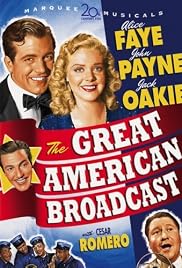
The Great American Broadcast (1941), 6+

After WWI two men go into radio. Failure leads the wife of one to borrow money from another; she goes on, after separation, to stardom. A coast-to-coast radio program is set up to bring ... 
1h 30min | Comedy, Musical, Romance, Sport | 9 May 1941
Director: Archie Mayo
Stars: Alice Faye, Jack Oakie, John Payne, Cesar Romero, The Ink Spots, The Nicholas Brothers.
Nick Castle ... dance director


I'd rated this before. The way it portrays the technology is familiar. I remember being tickled that the earliest radio was a headset experience. JO even has a line about how it's just you and the radio, nothing else interferes.

The musical highlight of the film is Ch 11, where the Ink Spots sing and the Nicholas Brothers dance to Alabama Bound; in the Tap! Appendix for the NB. The Ink Spots sing again in Ch 22. The Wiere Brothers appear twice, and leave an amazing amount of dead air with their silent physical humor both times. I doubt that happened much in the days of studio production, and they were in studio. Their dancing is not worthwhile; they're not much competition against the Ritz brothers for precision or comedy. Just FFWD'd through the film, the only dancing was done by brothers.

AF delivers good singing, as usual, sometimes joined by JP & JO. I'm pretty sure all the songs are radio performances. AF & JO do the bulk of the acting. Cesar Romero is a bright/breezy rich guy who finances the some early experiments and therefore benefits financially from being in on the ground floor of radio broadcasting. The romantic graph this time has 3 men smitten with AF, and JP plays too hot-tempered for my taste, but they are the couple that marries and reconciles. JO is claimed by his secretary in the final shot, and CR walks away with only his looks, charm and money.

Fox, dir. Mayo; 6+

Affectionately Yours (1941), 6- {nm}

A married reporter's assignments carry him all over the world, which gives him ample opportunity to put the moves on the local females. He's in Lisbon attempting his latest "conquest" when ... 
1h 28min | Comedy, Romance | 10 May 1941
Director: Lloyd Bacon
Stars: Merle Oberon, Dennis Morgan, Rita Hayworth, Ralph Bellamy, George Tobias, James Gleason, Hattie McDaniel, Butterfly McQueen.

Watched online, ok print, but sound gets out of sync easily.

I must have found this movie online and decided to watch because of RH. It's not a musical and not tagged as such.

Ralph Bellamy got the short end of the stick on the credits, and again in the plot (he's the jilted fiance). MO, DM and RH were listed ahead of the title, and he leads the pack after it. He's onscreen at least as much as she, if not more.

I'd call this screwball comedy, and a comedy of remarriage. The problem is DM plays a reporter who lies frequently to get what he wants. Why should MO want him back? Apparently she can't help herself: whenever she thinks he's injured, she rushes to his side. Not well versed in Aesop's The Boy Who Cried Wolf, the screenwriters reward him for his mendacity in the end. 

Warner, dir. Bacon; 6-

Ziegfeld Girl (1941), 6

Discovery by Flo Ziegfeld changes a girl's life but not necessarily for the better, as three beautiful women find out when they join the spectacle on Broadway: Susan, the singer who must ... 
2h 12min | Drama, Musical, Romance | 25 April 1941
Directors: Robert Z. Leonard, Busby Berkeley
Stars: James Stewart, Judy Garland, Hedy Lamarr, Lana Turner, Charles Winninger, EE Horton, Eve Arden.
Busby Berkeley ... (musical numbers directed by)
Daniel Dare ... dance director: ensembles (uncredited) / special dance sequence (uncredited)
[not on the ZG page: Seymour Felix ... stager: dances and ensembles on The Great Ziegfeld ('36); clips included here in the finale]


This is a largely unpleasant tale about Lana Turner's descent into materialism, alcoholism, unemployment and ill health, and the impact on her immediate friends/relatives. It's a great showcase for her acting talents, but she does no dancing (only rhythmic walking, mostly on stairs.) The story also shows the conflicts of success for JG & HL, with happy endings for these.

Plenty of music and Ziegfeld showgirl numbers with lavish costumes. The costume sequences should have been in color. (MGM makes Ziegfeld Follies ('45) all color.) They re-use/recreate the top of the wedding cake set from The Great Ziegfeld to show JG's early progress; eventually she becomes a headliner.

We do get an actual dancing number: Minnie from Trinidad, with lots of dancers, a Flamenco-style specialty act, and JG singing.

In his introduction segment on the dvd, John Fricke says a new finale had been filmed, but they decided to use clips from the old film instead (he shows a brief glimpse, but no deleted scene is on the dvd?). The old clips were short and unsatisfying, but in the days before home video, I suppose people welcomed seeing old faves. Better to reissue the whole film, or use those clips in the beginning or throughout to enrich the environment. A finale should be something that makes us leave the theatre happy and wanting more. Busby Berkeley was the king of finales in the mid-30s. Seems like this production hit a snag of some sort.

MGM, dir. Leonard; 6

That Night in Rio (1941), 6+ Color

An entertainer in Rio impersonates a wealthy aristocrat. When the aristocrat's wife asks him to carry the impersonation further, complications ensue.
1h 31min | Comedy, Musical | 11 April 1941 | Color
Director: Irving Cummings
Stars: Alice Faye, Don Ameche, Carmen Miranda, S.Z. Sakall.
Hermes Pan ... dance staged by
Angela Blue ... assistant choreographer (uncredited)

http://www.imdb.com/title/tt0034273/

It's impossible to know how I might feel about this if I hadn't seen it's very close antecedent (blog link for) Folies Bergère de Paris (1935), 7. The translation is from Paris to Rio, and from Maurice Chevalier to DA, Merle Oberon to AF, Ann Sothern to CM and Eric Blore to Cuddles Sakall.

Because the male lead is playing 2 roles (the aristocrat and the show-biz impersonator), this is a primary ingredient for the film. I like DA in most things, and I might have praised him here, but DA is no Maurice Chevalier. MC oozes charm where DA is pleasant. MC expresses distress a little better than stalwart DA.

I like DA's singing, but at one point early in the film, when we'd had a number from CM, and DA started singing a third song, I did a double-take, asked "again?" and wondered when AF would sing (she does).

Color is still a novelty at this point, and they made excellent use of it with CM's costumes, the sets, and especially the women's multi-colored skirts in the opening number Chica Chica Boom Chic. However, I tend to agree with those who say color is a distraction, even in a farce. At one point AF wears a gold lame gown that drew my attention, when I should have been focused on her. Speaking of distracting costumes, in Ch 19 AF wears a fur-trimmed peignoir that looks identical to something Betty Grable wore in an earlier film (probably Down Argentine Way ('40), except I remember hers being silver/blue, and this is beige/tan.)

Ann Sothern was pretty loud and obnoxious as the impersonator's girlfriend in '35, but CM does it in rapid Portuguese and on very high platform shoes with huge fruity turbans on her head. (DA replies in English so we can understand.) Both versions are annoying.

AF brings more warmth, depth and music to her role than did Merle Oberon, but Oberon makes a more convincing aristocrat who lives a separate life from her husband.

Except for the opening number, all musical numbers are singing only, except for some social dancing. Even the finale, a patchwork of reprises, has no choreography. And in the opening number, I felt some of the men in the foreground looked under-rehearsed. (The women were just a multi-colored blur. Again, distracting.)

I think I cannot recommend this film, even though I mostly like it. And I still don't know how much my appreciation of Chevalier in '35 is pulling my opinion down.

Fox, dir. Cummings; 6+

Thursday, January 18, 2018

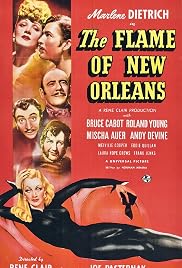
The Flame of New Orleans (1941), 6- {nm}

In old New Orleans, a beautiful adventuress juggles the attentions of a rich banker and a dashing sea captain.
1h 19min || 25 April 1941
Director: René Clair (as Rene Clair)
Writer: Norman Krasna
Stars: Marlene Dietrich, Bruce Cabot, Roland Young, Andy Devine, Mischa Auer, Franklyn Pangborn

Genres: Adventure | Comedy | Music | Romance

The drawing of MD reclining in a slinky black gown is completely inappropriate. This is a period film, just past the hoop-skirt era. Nor was her hair down.

I could list several additional familiar names from the cast list, but I'll stop there. I don't find Bruce Cabot appealing at all. Had the role been played by Gary Cooper or John Wayne, it would have been a far better film.

MD plays a woman who manipulates events to gain a proposal of marriage for money, but then meets a manly man and changes her mind at the alter. The End.

In no way should this have been classified Music. I set my standards against Mae West films where she sings 3 or more songs, and IMDb does not allow Music. Here MD sings 1, and the sailors sing another. There is no dancing to speak of.

MD gets to act 1.5 roles: the "countess" who then pretends to be her own cousin to help cover her bad behavior in St. Petersburg some time earlier. 

Theresa Harris plays MD's maid, and visually comments on her mistress' behavior (eye rolls, raised eyebrow, hidden smile). She was also delightful in Buck Benny Rides Again and Love Thy Neighbor last year as Rochester's sweetheart/dice shark, occupation: maid. (The word Maid appears 36 time among her 90 film credits; I'm willing to bet that many of her name-only roles hold that occupation as well.) We see her with a handsome young man of color two or three times, but I didn't catch the character name and couldn't determine his identity from the credits.  

This is a toss-up between 5 and 6; for MD & TH I'll tilt to the right.

Universal, dir. Clair, 6-

Golden Earrings (1947), 7 {nm}

On the eve of World War II (1939) English officer Ralph Denistoun is in Nazi Germany on an espionage mission to recover a poison gas formula from Prof. Krosigk. He is helped by Lydia and ... 
1h 35min | Adventure, Romance, War | 27 August 1947
Director: Mitchell Leisen
Stars: Ray Milland, Marlene Dietrich, Murvyn Vye

http://www.imdb.com/title/tt0039428/
Watched "accidentally" on double-sided disc for The Flame of New Orleans ('41).

Very satisfying cusp-of-war yarn about RM seeking a MacGuffin, encountering Gypsy Lydia (MD), and learning to live and love like a gypsy while pursuing his goal. The story also slightly illuminates how paranoid you must be under a totalitarian regime. MD's performance is excellent as usual. The ending befits the tale.

Paramount, dir. Leisen, 7

Road to Zanzibar (1941), 6

Stranded in Africa, Chuck and his pal Fearless have comic versions of jungle adventures, featuring two attractive con-women.
1h 31min || 11 April 1941
Director: Victor Schertzinger
Stars: Bing Crosby, Bob Hope, Dorothy Lamour, Una Merkel, Eric Blore, Douglass Dumbrille.
LeRoy Prinz ... stager: musical numbers

Genres: Adventure | Comedy | Musical | Romance

6+ songs in the Soundtracks, but I don't remember them immediately after watching this. The plot/antics are what stand out.

FFWDing through it again to find dancing: there is a dance sequence at one show with chorus girls; H&C join them onstage to evade authorities.

We have the BC/BH duo traveling the African continent performing danger acts (Hope is endangered, Crosby is the barker) at carnivals. Why Africa? So they can get into tribal trouble, I suppose.

Eric Blore's appearance is all too brief, as the diamond heir who sells them a bogus lost mine. When they turn that purchase around to a local gangster, they must flee. Then they're hoodwinked by Merkel & Lamour, who further convince H&C to take them into the jungle. During this trip Lamour sings romantically to Hope. M&L slip out of the story (I don't know where), and H&C are captured by natives with such elaborate face and body paint that you don't think about the race of the actors, but the Chief is Noble Johnson, African American, and the Hall Johnson Choir is in the credits.

After Hope wins a wrestling match with a gorilla, the boys are freed, return to local modernity, find the girls, and now have a 4-person carny act. Curtain.

It's an ok bit of fluff, but don't watch this thinking you're gonna get a rousing musical. Comedy is the focus.

Paramount, dir. Schertzinger; 6

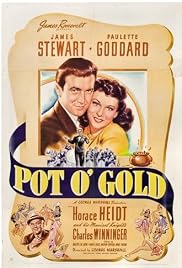
Pot o' Gold (1941), 7

Jimmy, the owner of a failed music shop, goes to work with his uncle, the owner of a food factory. Before he gets there, he befriends an Irish family who happens to be his uncle's worst ... 
1h 26min | Comedy, Musical, Romance | 3 April 1941
Director: George Marshall
Stars: James Stewart, Paulette Goddard, Charles Winninger
Larry Ceballos ... dance director

Watched at AmazonPrime, decent print; have on a megapack.

I spotted Art Carney at the dinner table when they sing the initiation song for JS; his credit is listed as Band Member / Radio Announcer (uncredited).

The Soundtracks page lists 6 songs. It doesn't say PG's vocals are dubbed, but I suspect they are. We get a big production number with PG dancing (in drag as the Broadway Caballero part of the time). 

The beginning of the film has tons of folksy charm, with harmonica music and acapella singing. The plot is driven by the CW's hatred of music. The end has a frantic comedy scene, with a cutesy doubly happy ending. 

James Roosevelt Productions, distr. UA, dir. Marshall; 7

Blondie Goes Latin (1941), 7-

Dagwood disguises himself as a drummer in the ship's conga band to sneak aboard a South American cruise ship. Blondie performs several song-and-dance routines.
1h 8min | Comedy, Music | 27 February 1941
Directors: Frank R. Strayer, Robert Sparks (uncredited)
Stars: Penny Singleton, Arthur Lake, Larry Simms

http://www.imdb.com/title/tt0033403/
Watched online, decent print.

My reaction when this was done: now THAT'S a musical. We get enough musical numbers and a fun finale. The plot was simple, but gave the characters a lot of conflict. Penny Singleton can sing and dance, and we have 2 other singers aboard. It's lacking an ensemble piece, and has no fancy choreography, and no fancy tracking or overhead shots, but they did have an interesting moment where the camera was on toe-level as PS danced toward it. If this had an official release, I'd buy it.

The only other Blondie movie tagged as musical was Blondie Meets the Boss (1939), 5 {nm}, and 5 {nm} tells you a lot. I'd seen a clip of PS in the first version of Good News ('30), so I wasn't surprised by her skill. 

The plot: Mr. Dithers, Dagwood's boss, is taking the Bumstead family on a cruise to South America for his health (and because his wife can't go.) A business deal intervenes, and Dagwood needs to stay behind. But as he departs the ship, he's caught by a porter trying to bring a base drum up the gangplank. Since they can't pass each other, Dagwood takes the drum up to the ship, and ends up with the band aboard the ship. He needs to hide from Mr. Dithers, and the band's drummer missed the boat, the band will get fired without a drummer, so Dagwood settles in as a very awkward drummer. Of course, a drummer is too conspicuous, so the girl singer dresses him as a woman.

Blondie misses Dagwood, and he wants to tell her he's aboard, so just as Dithers places a phone call to shore, Dagwood calls that phone. The girl singer's room is adjacent to the Dithers/Bumstead suite, and the doors are open. Daisy the dog hears Dagwood's voice, and runs into his room barking. Blondie almost figures out that she's hearing the dog in stereo, but not quite. Because Mr. Dithers is in the room with Blondie, Dagwood does not explain where he is.

The other singer aboard is a businessman traveling by ship, and is indirectly involved in the business deal that should have kept Dagwood at home. Tito Guizar has a lovely tenor voice (he had a specialty in The Big Broadcast of '38), and he sings a love song, which makes her miss Dagwood. He pursues her out to the deck with his guitar, and teaches her the song in English, so we get her lovely soprano blending with his voice.

Because a waiter is carrying one of Dagwood's signature sandwiches back to the kitchen, Blondie discovers Dagwood in the girl singer's room, assumes the worst, but doesn't get loud or hysterical. It's a great scene. She doesn't realize Dagwood was getting his drag costume. 

She goes back to her cabin and sings her new song to a sleeping Baby Dumpling (the actor is age 6, but playing younger; Dumpling had a earlier duet of his own with a similar-aged piano player/singer), and finally Blondie cries. But then she goes out, meets TG, and let's him comfort her. When she spots Dagwood in drag behind the drums, she gets mighty steamed (with a cute cartoony thought-montage of heavy equipment that produces steam/smoke), and lays it on thick with TG. This is when we get her singing and dancing.

Eventually things are resolved, including the business deal that should have kept Dagwood home. For the finale, we get a reprise of the song she learned, with her dancing again but now with Dagwood stripped of his dress and wig. Dumpling dances with his little friend, and Daisy dances with the little girl's dog. The End.

I really liked this! It's not high glamour, and not fabulous dancing, but the plot and the music gave us an entertaining B-level musical. And it was really nice to see Blondie away from her apron. 

Columbia, dir. Strayer & Sparks; 7-

Road Show (1941), 6

Rich playboy Drogo Gaines is in imminent danger of marrying a gold digger, and escapes by feigning insanity. The joke's on him when he wakes up in an asylum full of comical lunatics. There ... 
1h 27min | Comedy, Music | 18 February 1941
Director: Hal Roach
Stars: Adolphe Menjou, Carole Landis, John Hubbard, Charles Butterworth, Patsy Kelly, Willie Best

Watched at Amazon Prime; also in a megapack. 

A vocal group called The Charioteers sing a few songs. They have beautiful harmony, but they don't do enough of it to make this genre Music or Musical for my money. But I won't be militant about it. Once they back up a singer on stage (Roach's daughter?), another they sing while doing roustabout chores. Carole Landis sings (dubbed) in the shower with unseen backup harmonizers. There's a 4th in the Soundtracks, but I can't find it on the Prime preview images.

The Road Show of the title is a traveling carnival, which, based on a lie that their new member (the playboy) is a tamer, adds lions to the mix.

Things get very physical (Hal Roach produced and directed), and Adolphe Menjou does as much shtick as the next man. Willie Best is at his exaggerated cowardly, well, best, but overcomes his fear and manages to recapture the escaped lion. Butterworth brings his usual wealthy eccentric to the show. Carole Landis and Patsy Kelly are the proprietors of the Show, which is in debt, of course. John Hubbard is handsome, and sufficiently wacky for the script. The ending is very happy.

Hal Roach Studios, distr. UA, dir. Roach; 6

Wednesday, January 17, 2018

Her First Romance (1940), 6-

A rather plain coed Fellows and her beautiful sister Wells compete for the same man Evans. When Ladd thinks Evans is moving in on Linden he knocks him down, but things get straightened out.
1h 17min | Drama, Musical | 25 December 1940
Director: Edward Dmytryk
Stars: Edith Fellows, Wilbur Evans, Julie Bishop, Alan Ladd

http://www.imdb.com/title/tt0032581/
Watched online, mediocre audio/video.

Alan Ladd had 15 credits for unnamed parts, and a total of 28 credits before this one. So it's hard to determine (without opening the page for every named credit, or perhaps even seeing the other films) whether this was his meatiest role to-date. Certainly the onscreen credit before this one, for Republic, had him 8th billed, and I recognize 3 of the names ahead of his; but another uncredited role appears in a film in between. He is 4th billed here.

Edith Fellows (b. '23, the plain coed) and Wilbur Evans (b. '05) are the operatic singers (he professional) who find mutual attraction. 

EF has 2 sisters (or partial sisters), one overconfident, the other also underconfident. Alan Ladd is paired with the overconfident one, until he returns from an out of town trip. The overconfident one also falls for WE, so we have a love pentagon here, with nearly all the vertices connected.

WE makes only 1 other film, and has stage credits in his Other Works. 

EF was a child actor, starting in '29, with 48 credits through '42, two more in the 60s, two more in the 80s (so 52 total). She makes only 9 films after this one. She has stage credits too.

I was wondering why 5'6" Alan Ladd looked so tall. EF is listed as 4'10".

Nice music, and better than expected plot. I wouldn't call this a drama. Just a romance.

Notice the director. He goes on to helm some very good films: Murder, My Sweet ('44), Crossfire ('47) and The Caine Mutiny ('54).

Monogram, dir. Dmytryk; 6-


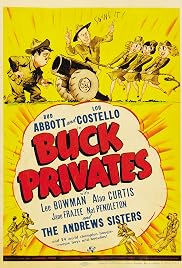
Buck Privates (1941), 6

Bud and Lou enlist in the army in order to escape being hauled off to jail, and soon find themselves in basic training. To their dismay, the company's drill instructor is none other than ... 
1h 24min | Comedy, Musical, War | 31 January 1941
Director: Arthur Lubin
Stars: Bud Abbott, Lou Costello, Lee Bowman, The Andrews Sisters, Nat Pendleton.
Nick Castle ... dance director

http://www.imdb.com/title/tt0033436/

In Tap! Appendix for the Andrews Sisters. I think that's for only 1 number, and I'm not going to track down where it is. It's not that great; they're singers, not dancers. We get 2 of their most familiar hits in this film: Boogie Woogie Bugle Boy and (I'll Be with You) In Apple Blossom Time (from 1935), plus 2 more.

We get some ensemble and specialty dancing, but it's all just social dancing by expert jitterbuggers (or whatever the next phase was called.) We don't get any pretty poses, pleasing formations, or the sort of dance studied from childhood (ballet, tap, etc.).

Because the dvd Production Notes include it, here are the stock A&C routines included in this film: Dice Game (where LC supposedly knows nothing, but uses all the proper slang for things), You're Forty, She's Ten (where math is the target: now she's 1/4 your age...in 20 years she's half your age; when will she catch up to you; answer: infinity), and the Drill Routine, where BA commands a quartet of soldiers to turn, march, etc, but LC gets in a wrong position and botches it all up.

Jane Frazee is a name that headlines many B movie musicals (that are largely not released to DVD as of 2018). She plays the USO-style hostess here, and sings a song that I missed. 

Also included on the DVD is a commentary track, skippable. But then, so is the whole movie. I got this set for the musicals (11 of the 28 titles). I knew it would be iffy. But the next one has Condos Brothers, so I'm hopeful on that one.

Universal, dir. Lubin; 6

Love Thy Neighbor (1940), 6-

Jack Benny is preparing his New Year's Eve radio broadcast but takes time out to take his valet Rochester to meet his girlfriend Josephine arriving on a steamer. Fred Allen and his sister ... 
1h 22min | Animation, Comedy, Musical | 27 December 1940
Director: Mark Sandrich
Stars: Jack Benny, Fred Allen, Mary Martin, Eddie 'Rochester' Anderson.
Merrill Abbott ... choreographer

http://www.imdb.com/title/tt0032730/
Watched online, poor print, esp. audio.

Film premiere of Cole Porter's My Heart Belongs to Daddy, sung by MM. 3 other songs: Lyrics by Johnny Burke, Music by Jimmy Van Heusen.

The whole film is based on the Benny/Allen rivalry, and I don't find it cute or funny. Did people really like that on radio?

The best reason to watch this is for the musical numbers, and they are too few and too short. Rochester sings to his date at the New Years Eve (Harlem) ball. But he doesn't dance (as he did in the prior film.) MM sings Daddy. We get some rhythmic gymnastics in another show number, and chorus girls backing JB's lame leg movements. But these are just part of JB's stage show, nothing to do with the plot (Rochester's song DOES pertain to his dicey romance (pun intended: his gf takes him for some loot with her loaded dice).)

Part of the problem is the print, so I'll give it the benefit of the doubt.

Paramount, dir, Sandrich; 6-

Go West (1940), 7

The Marx Brothers come to the rescue in the Wild West when a young man, trying to settle an old family feud so he can marry the girl he loves, runs afoul of crooks.
1h 20min | Comedy, Musical, Western | 6 December 1940
Director: Edward Buzzell
Writer: Irving Brecher (original screenplay)
Stars: Groucho Marx, Chico Marx, Harpo Marx.
Bobby Connolly ... dances (uncredited) [what dances?]

http://www.imdb.com/title/tt0032536/

Lots of songs and silliness. 

Groucho and Chico negotiate, this time with Harpo enhancing the results: Groucho sells them a hat and coat, but they pay with a $10 bill on a string, and the items cost only $1 each. Somehow a 3rd transaction is added, and Harpo has to get more extreme to retrieve that $10 bill.

Chico plays the piano, Harpo "plays the harp" (actually a loom, and this is NOT the instrument making the sound, because you see strings vibrate at the high end which are actually much longer that would make the high sound.)

The plot involves a land deal with a railroad company, and who's got the deed to that land. Bad guys want to sell their own land to the railroad, so they try to sabotage the transaction. And this is no bookkeeping sabotage: we get a wild non-stop train, and the MB become the engineers (with Groucho trying to read the manual as they go.)

It works for me. (Not sure why we have a dance director. Really. I just FFWD'd through the whole thing, and no dances.)

MGM, dir. Buzzell; 7

Tuesday, January 16, 2018

Second Chorus (1940), 6+

When perennial college students Danny O'Neill and Hank Taylor are forced to make it on their own, the competitive pair get jobs with Artie Shaw's band and reunite with ex-manager Ellen Miller.
1h 24min | Comedy, Romance, Musical | 3 January 1941 |
3 December 1940 (New York City, New York) (premiere)
Director: H.C. Potter
Stars: Fred Astaire, Paulette Goddard, Artie Shaw, Charles Butterworth, Burgess Meredith
Hermes Pan ... dance director

http://www.imdb.com/title/tt0033029/

This was in public domain hell for a long time (I have this in 2 megapacks), then Image Entertainment got some good source material and issued a worthy release.

Very nice to see PG dancing after all those credits as a Goldwyn Girl. Her career popped when Charles Chaplin, her "husband" 6'36-6'42, starred her in Modern Times ('36). She married BM 5'44-5'49, and this is their 1st of 4 pairings, the last in '49. (She had 4 husbands, all writers to some extent. The 4th ('58-'70, his death) was Erich Maria Remarque, author of All Quiet on the Western Front, among others.) PG's other film with Chaplin, The Great Dictator had a limited release in 10'40, then wide in 3'41. Here she shares the pre-title billing card with (same level, to the right of) FA. That's 4 years and only 8 films after MT, and she was still a Goldwyn Girl in the film before MT.

This plot point is aggravating: although FA & BM were supposed friends, roommates and bandmates for 7 years (in college. Problem: they kept flunking to stay. I doubt that worked, even in the 30s.). And yet they seem always contentious. One bought an encyclopedia in the other's name, throwing him into debt. One turned in a terrific term paper for the other, so he wouldn't flunk (remember: he wanted to flunk; BTW, the paper was plagiarized from that encyclopedia.) They play their trumpets over one another, not to complement each other. And then the beautiful, competent, up-beat girl comes along, and they really pit themselves against each other, but then BM trusts FA near the end. Huh?

The dancing is definitely not enough. We get only 1 pairing of FA with PG, and it's not romantic, but it is fun, and the number I remember most. It's the first dance number, and the singing begins almost 15 min into the film. FA has only 2 solos: ~45 min in, lasts less than 1.5 min, in a Russian restaurant in a heavy costume and using Russian-style moves; and ~1:18:30, lasts 3.5 min, dance-conducting the Artie Shaw orchestra for the Poor Mr. Chisholm number. NO ensembles or chorus boys/girls anywhere in the film.

Other than the dances, we get musical interludes from the FA/BM college swing band, Artie Shaw does a nice number with his band, and maybe 5 other tunes, but that includes 2 botched auditions. Artie Shaw himself is a prominent character, but his acting feels like he's wrapped in cellophane. (It's really hard to understand why/how he married 8 times. I get no charm onscreen.) Astaire is the only singer in the film. He's fine; the songs he sings, not so much.

Paramount, dir. Potter; 6+

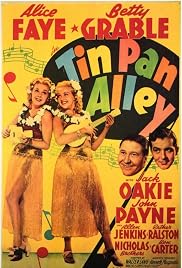
Tin Pan Alley (1940), 6+

Songwriters Calhoun and Harrigan get Katie and Lily Blane to introduce a new one. Lily goes to England, and Katy joins her after the boys give a new song to Nora Bayes. All are reunited ... 
1h 34min | Drama, Musical, Romance | 29 November 1940
Director: Walter Lang
Stars: Alice Faye, Betty Grable, Jack Oakie, John Payne, Nicholas Brothers.
Seymour Felix ... dance stager
Al Siegel ... assistant dance director (uncredited)

bootleg, but a good print.

In Tap! Appendix for the Nicholas Brothers in The Sheik of Araby (1921) number. The whole number begins around 1:15:00, and NB appear in the middle-ish third of 6+ minutes. The choreography of the non-NB portions is very tame. Can't wait for Jack Cole to arrive in Hollywood; his first credit is appearing with his troupe in Moon Over Miami ('41).

Per the IMDb Soundtracks page: One love song (You Say The Sweetest Things (Baby)) premiered in the film. Otherwise the numbers are all period pieces from the era (mostly 1910s).

1st of 4 pairings of AF (b. 1915) & JP (b. 1912). They both act well, and are believable as love-at-first-sighters. The plot and writing are clearly focused on them, although Jack Oakie gets plenty to do and does plenty with it (I like him). The fuzzy lollipop goes to BG, who already starred in Down Argentine Way (this year), and acted well there. Here she's a repeatedly featured specialty act with lines. I wonder if she watches AF's performance in The Sheik of Araby number, and realizes what a wink, a knowing smile, a roll of the eyes, a wiggle of the head can add to the performance. I get the idea she is very focused on her feet and arm movements. AF is acting while she performs.

The film is pleasant, and conveys some of the history of the titular locale & era. Nicholas Brothers do a remarkable splits-stunt at the end of their routine, and some lovely tapping, but I don't like their costumes or the photography (or maybe it's the set that seems cluttered and cumbersome, or all of the above). Anyway, we just saw them in tuxedos (Down Argentine Way), so this is a little cringe-worthy (are they skinny eunuchs? I thought that's biologically impossible, that removing the testicles creates fat/beefy men.) I just talked myself out of a 7.

Fox, dir. Lang; 6+

Little Nellie Kelly (1940), 6+

Irish colleen Nellie is in love with handsome Jerry Kelly, even though her father objects. Nellie and Jerry soon marry and announce plans to move to New York, which again angers Nellie's ... 
1h 38min | Comedy, Family, Musical | 22 November 1940
Director: Norman Taurog
Stars: Judy Garland, George Murphy, Charles Winninger

http://www.imdb.com/title/tt0032718/

With JG & GM in the cast, I was hoping for some good dancing. Unfortunately, this is a period piece covering 2 generations of Nellie, and the elder Nellie dies in childbirth long before the swing era. GM plays the husband of elder Nellie, father of younger, so by the time JG is old enough to dance with GM, he's too old to leap about the way he should. They do have a social dance together, very father/daughter.

JG sings some songs, including a swing update of Singin' in the Rain. There are couple of songs by George M. Cohan (the author of the original play), and one by Roger Edens (plus a traditional song adapted by him).

JG acts up a storm, and is well matched to her costars. The conflict driving the plot is resolved well. Her party gown for the finale is a great blend of glamour and youth; very pretty.

MGM, dir. Taurog; 6+


Monday, January 15, 2018

Fantasia (1940), 6

A collection of animated interpretations of great works of Western classical music.
2h 5min || 21 July 1941 (UK) | 13 November 1940 (New York City, New York) (roadshow version)

Directors: James Algar (uncredited), Samuel Armstrong (uncredited) | 10 more credits
Stars: Leopold Stokowski, Deems Taylor, Corey Burton

Genres: Animation | Family | Fantasy | Music

I don't like Disney animation. I don't like Mickey Mouse. I don't like Fantasia. It's all too slick, too sweet, even when depicting evil and horror. I like the music, but resisted buying/watching this until Mar 2014, and got a good deal ($16 for the 3-disk anthology, which is offered used now on Amazon for $26, and new for $95.) So maybe someday I'll have the patience to actually sit and watch it, maybe in segments, because it makes me antsy as real ants would.

I previously rated this 6, and I'll leave it. But if I were rating this fresh today it would be 5.

Disney, dir. various; 6

No, No, Nanette (1940), 5+

Perky young Nanette attempts to save the marriage of her uncle and aunt by untangling Uncle Jimmy from several innocent but ensnaring flirtations. Attempting one such unentanglement, ... 
1h 36min | Musical | 20 December 1940
Director: Herbert Wilcox
Stars: Anna Neagle, Richard Carlson, Victor Mature, Roland Young, Helen Broderick, Zasu Pitts, Eve Arden.
Aida Broadbent ... choreographer

Watched online, mediocre print. Several other posts available.

Well, it began with a promising rendition of I Want To Be Happy, but declined into a heavy ratio of comedy:song. And the comedy is frantic because Nanette is trying to protect her uncle from the consequences of his actions, over and over and over again. Yes, at least 3 blackmailers/gold diggers are trying to bilk him for favors and/or cash because he'd previously helped them, and his wife might not understand. Tiresome.

Only 2 other songs appear: the title song, and Tea For Two, and then all three are melding into a medley to which AN dances in her own dream. But AN does not dance much, perhaps less than Marilyn Miller (who could get en pointe, as I recall). The chorus girls behind her don't dance much either; that would highlight her shortcomings, I suppose.

So, mediocre print, tiresome plot, weak musical numbers. The + is for familiar songs.

Suffolk Productions, distr. RKO, dir. Wilcox; 5+


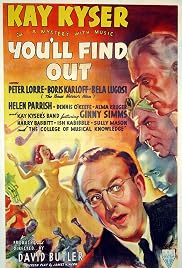
You'll Find Out (1940), 5+

The manager of Kay Kyser's band books them for a birthday party bash for an heiress at a spooky mansion, where sinister forces try to kill her.
1h 37min || 22 November 1940
Director: David Butler
Stars: Kay Kyser, Peter Lorre, Boris Karloff, Bela Lugosi, Dennis O'Keefe, Ginny Simms

Genres: Comedy | Horror | Musical | Mystery | Romance
Watched online; sharp print.

This is more Comedy | Horror than Music (and it shouldn't be Musical). Here's a list of 34 Comedy | Horror films through 1940 (this one is next to last), dating back to 1917. The 1st 9 are silent, the 10th has talking sequences. #16 has Bela Lugosi in the stars visible on the results (so among the top 4 billed), #18 has Boris Karloff; this is the 1st to have Peter Lorre, and all 3 are visible. Searching for collaborations, this is the only film title where all 3 work together.

This is the first musical I've seen where Dennis O'Keefe is not a chorus boy, and since we get no dancing, not even social dancing, he doesn't strut any stuff.

Kay Kyser is definitely the star of the film, doing the heavy lifting to solve the mystery. He's not particularly heroic, but he persists when others want to withdraw. (Of course, there's no where to go; the bridge was blow up after their arrival, but before the invited dates for the girls could arrive.)

This genre is not up my alley, although since it's comedic instead of scary, it's tolerable. Previously rated this a 4; no idea why, unless the print was awful. Then again, I think I've become more tolerant of mediocrity in this quest.

RKO, dir. Butler; 5+

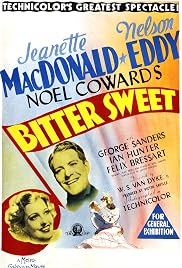
Bitter Sweet (1940), 6 Color

In order to avoid an arranged marriage with a man she doesn't love, Sarah Millick runs off to Vienna with her music teacher, Carl Linden, whom she does love. They are married. In Vienna, ... 
1h 34min | Drama, Musical, Romance | 8 November 1940 | Color
Director: W.S. Van Dyke (as W.S. Van Dyke II)
Stars: Jeanette MacDonald, Nelson Eddy, George Sanders

Official release, but color frame mis-matching blurs somewhat.

Yes, IMDb lists songs written by Noel Coward in 1929 (with some lyrics by Gus Kahn).

The plot summary continues:
In Vienna, they struggle to make a living by making music. Carl writes an operetta and tries to get it produced. They are helped along by Viennese Baron, but his intentions are not honorable. He kills Carl in a sword fight. A big producer does put on the operetta, with Sari in the lead -- but without her husband, it is a bittersweet victory. Written by John Oswalt 
The Viennese baron is played by George Sanders. There's an Englishman (Ian Hunter) involved too, a gambling mate of the Baron, and I thought HE had connected the couple to the restaurateur (weird that the n is missing from the correct spelling) who employs the couple. They both show up there, and when GS makes an aggressive pass at JM, NE steps in, and the duel begins immediately (no demanding satisfaction and seconds arranging a duel at dawn,) After the successful opening of NE's operetta, JM goes back to their 5th floor walkup garret, and sings to him in heaven.

The lack of color restoration is worse in some reels than others, and is distracting. But the plot itself is uneven: I watched multiple times to try to capture it (falling asleep each time), and still couldn't get the whole thing. The music is also uninspiring (and of course unfamiliar). And while JM admires NE for his talent, this doesn't have the heroic sweep of their best stories.

MGM, dir. Van Dyke; 6

One Night in the Tropics (1940), 6+

Jim "Lucky" Moore (Allan Jones), an insurance salesman, comes up with a novel policy for his friend, Steve (Robert Cummings): a 'love insurance policy', that will pay out $1-million if ... 
1h 22min | Comedy, Music | 15 November 1940
Director: A. Edward Sutherland
Stars: Allan Jones, Nancy Kelly, Robert Cummings, Abbott & Costello, Mary Boland, William Frawley.
Larry Ceballos ... dance director

http://www.imdb.com/title/tt0032873/

AJ gets 4 songs, plus one of the female leads duets with him, and the other sings another solo (both fems are dubbed per IMDb). We get a large group dancing in the chase/finale, including an adagio specialty, whose fem lands in the arms of the chasers multiple times during the chase.

The plot is busy:

  • RC is engaged, but alienates his fiancee's aunt (MB). 
  • His friend AJ gives him a "love insurance policy" to pay out $1M if RC does NOT get married. He doesn't buy it for the payout, but because AJ is "lucky" and has never had to pay on a policy. 
  • AJ's father refuses to accept the policy, so he gets gangster(?) WF to back it. A&C work for him,
  • Enter RC's ex-girlfriend (wife?), who's determined to win him back.
  • AJ finally meets the fiancee, and is smitten.
  • To cover the identity of the Ex from the fiancee, AJ pretends the Ex is his gf.
  • RC gets jealous while observing AJ and his Ex.
  • Everyone goes on a steam ship, chasing fiancee who's running away.
  • Fiancee's interest in AJ is peaked.
  • AJ must decide whether to give up $1M or claim fiancee for himself.
  • WF & A&C are along to enforce the insured marriage.
  • The aunt and her dog are still along to help stir the pot/plot.
  • Fiancee learns about the insurance policy, is offended.
  • The signal for the celebratory dance (of the whole village?) is a gun shot, which happens prematurely as WF holds the insured couple at gunpoint but gets knocked over by AJ.
  • Chase commences (AJ & fiancee chased by WF, A&C), while the Ex holds the minister (mayor?) at gunpoint with RC.
In addition to interrupting the story for songs, we get interruptions for A&C do 5 of their routines: 
  1. 2 Tens for a Five
  2. 365 days - Firing
  3. Jonah and the Whale
  4. Mustard
  5. Who's on First (segment, with some unfamiliar, and welcome, twists)
I'm not sure how the insurance aspect of the plot is resolved, but I think at least 1 couple got married. A little taxing, but kinda fun.

Universal, dir. Sutherland, 6+

Sunday, January 14, 2018

Down Argentine Way (1940), 7 Color

An American girl on vacation in Argentina falls for a wealthy racehorse owner.
1h 29min || 11 October 1940 | Color
Director: Irving Cummings
Stars: Don Ameche, Betty Grable, Carmen Miranda, Charlotte Greenwood, Henry Stephenson, Nicholas Brothers.
Nick Castle ... dances stager
Geneva Sawyer ... dances stager

Genres: Comedy | Drama | Musical | Romance | Sport
http://www.imdb.com/title/tt0032410/
Beautiful color print!

First American film for CM (b. 1909; 6 prior films, probably Brazilian). 7th film for Fayard & 8th for Harold Nicholas, starting in '34 and '33 respectively; we get another with them this year. This film is in Tap! Appendix for them.

According to IMDb trivia: CM filmed her numbers in a NY nightclub (no one in the cast is onscreen with her). Also, BG was not the only replacement (for an ill Alice Faye). DA replaced Desi Arnaz ("personal reasons"), and Leonid Kinskey replaced Cesar Romero (also ill). 

Soundtracks:

  • ch 2 (ch 1 is titles only): South American Way, sung by CM
  • ch 5: Down Argentina Way, sung by DA in Spanish, by BG in English, danced by BG
  • ch 9: Down Argentina Way, sung by HN, danced by NB; don't miss FN's jump through a handkerchief into a split.
  • ch 10: Nenita, sung by trio, and then Leonid Kinskey, danced by specialty couple
  • ch 11: Mama Yo Quiero, sung by CM
  • ch 12: Bambu, Bambu, sung by CM
  • ch 15: Sing to Your Senorita, sung/danced by CG (b. 1890; trots more than dances)
  • ch 17: Two Dreams Met, sung by DA & BG
  • ch 23: Mama Yo Quiero, danced by BG 
  • ch 24: finale: reprises of all other songs, including NB hopping and landing in repeated splits, and CG finally doing her signature rubber-hipped high kicks
The commentary track is pleasant but skippable. The Biography episode on BG is OK, but her life is shown as tough at the end because of all the $$ consumed by husband Harry James; the daughters weren't interviewed. Alice Faye was, and denies the rivalry between them.

Lots of good musical numbers and BG's breakout film (after working steadily in films since 1929!) The Soundtrack is independent from the plot, which is pretty good. 

Fox, dir. Cummings; 7

Too Many Girls (1940), 6

Mr Casey's daughter, Connie, wants to go to Pottawatomie College and without her knowledge he sends four football players as her bodyguards. The college is in financial trouble and her ... 
1h 25min | Comedy, Musical, Sport | 8 October 1940
Director: George Abbott
Stars: Lucille Ball, Richard Carlson, Ann Miller, Eddie Bracken, Frances Langford, Desi Arnaz, Hal Le Roy.
LeRoy Prinz ... dance numbers staged by

http://www.imdb.com/title/tt0033173/

Also featured: Van Johnson, his first film credit, and his only as "chorus boy." He's really out front and visible frequently; doesn't have a solo or a specialty, but he's often in the front row and a head taller than row mates. He actually speaks a line in the football stadium.

We get multiple large-ensemble production numbers, with Ann Miller and Hal Le Roy dancing specialties. In Tap! Appendix for them.

I spotted Jay Silverheels onscreen and confirmed him on IMDb, which also lists Iron Eyes Cody as an extra, and Harry James as an orchestra leader. Didn't see either of them.

The songs are all Rodgers & Hart, but the film is all about college football, as are a lot of the songs. Finally, when LB complains to RC that they never kiss, she sings (dubbed by another) I Didn't Know What Time It Was (re-used in the film Pal Joey ('57)), which transfers to Eddie Bracken re-telling the tale.

The finale had a lot of people moving in a very confined space, and lots of film cuts to compensate for the lack of movement. (Van Johnson was in the front row again, but usually with his back to the camera.)

This is the first pairing of LB & DA, but they don't interact much onscreen. In real life, they're married 6 months later. Other than an appearance in an episode of Ed Wynn's TV show, their next IMDb collaboration is I Love Lucy ('51). This is Desi's first film.

The live-action short on the dvd, Frances Carroll and the Coquettes is pretty good. Just a band and some specialty acts, but all women. In a few years, that would be explained by men being in the war. In '40 it's just a novelty.

RKO, dir. Abbott; 6


Spring Parade (1940), 6+

In this light and lovely romantic musical, a Hungarian woman(Deanna Durbin) attends a Viennese fair and buys a card from a gypsy fortune teller. It says that she will meet someone important... 
1h 29min | Comedy, Musical | 27 September 1940
Director: Henry Koster
Stars: Deanna Durbin, Robert Cummings, Mischa Auer, Henry Stephenson, S.Z. Sakall

http://www.imdb.com/title/tt0033095/
Watched online, mediocre print. Many other posts.

Really very pleasant comedy, with 4 songs sung by DD. Falls short of being a title I'd recommend, if only because I doubt a good print is available. I don't find a commercial release; seems to be in public domain. Ironic that 1 of its 4 Oscar noms is for cinematography.

As always, she's in good voice. The song It's Foolish But It's Fun lives up to its title. Bob Cummings is also very pleasant (he sings the song composed, but I doubt he was hired for his singing.) He reminds me a bit of Don Ameche (although DA sings much better), and RC is more likely to play a nervous type than a swashbuckler.

The 3 character actors Mischa Auer, Henry Stephenson, S.Z. Sakall add well to the mix. I'm surprised SZS is so low on the credits; he's fairly prominent, and MA is only in a short segment.

I hope this gets rescued from PD exile, but seems unlikely. I put it in my wishlist anyway.

Universal, dir. Koster; 6+


Saturday, January 13, 2018

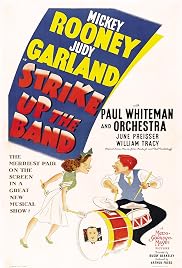
Strike Up the Band (1940), 6

Jimmy Connors and his girl-friend want to take part in Paul Whiteman's highschool's band contest, but they cannot afford the fare. But per chance the meet Paul Whiteman in person and are ... 
2h | Comedy, Musical, Romance | 27 September 1940
Director: Busby Berkeley
Stars: Mickey Rooney, Judy Garland, Paul Whiteman and Orchestra

http://www.imdb.com/title/tt0033110/

The title song is by the Gershwin bros, but 5 other songs are by Roger Edens. Others have much older publication dates (1920's all the way back to 1843).

The absence of a dance director in the credits was a warning sign. The dancing is high school kids social dancing, and occasionally doing fancier group movements, but I'm not wow'd by anyone.

I'm just not a fan of MR. His looks, his energy, his singing/dancing all just leave me cold. Apparently he was big box office then. He looks like he really was playing drums and xylophone.

The troubles of these teens (just graduated high school) just don't appeal to me.

MGM, dir. Berkeley; 6

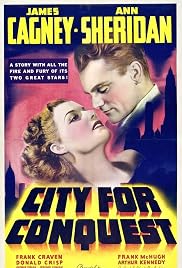
City for Conquest (1940), 6+

Danny is a content truck driver, but his girl Peggy shows potential as a dancer and hopes he too can show ambition. Danny acquiesces and pursues boxing to please her, but the two begin to spend more time working than time together.
1h 44min | Drama, Music, Sport | 21 September 1940
Directors: Anatole Litvak, Jean Negulesco (uncredited)
Stars: James Cagney, Ann Sheridan, Frank Craven, Donald Crisp, Frank McHugh, Anthony Kennedy, Anthony Quinn, Elia Kazan.
Robert Vreeland ... dance director

http://www.imdb.com/title/tt0032342/

Only qualifies as Music because we have some dance sequences with, but mostly dancers dubbing for, Anthony Quinn and Ann Sheridan, since they are competitive amateurs who turn professional. AQ abuses AS, inferring rape at one point. JC gets on the dance floor with AS briefly, but only social-dances from shoulders up.

The ugly nature of boxing, with the champ winning because he rubs rosin into his opponent's eyes (blinding him for life?) is a major plot thread. Making this tragedy even worse: JC never wanted to box professionally, and AS insists he get some ambition, so he caves.

And the whole thing is begun and ended with a hobo narrator, who somehow survives from when our characters are children (age 10?) to adulthood (JC is 41, but playing 25+?; AS was b. 1915). I don't think the homeless in NYC survive 15 years on the streets. And I don't see the point of introducing us to the characters as children; waste of time.

We get 2 murders right in front of us, one by EK, the other of him, with the worst dying line ever: "I never saw that coming." or something like it.

Schickel's commentary track is worth skipping. He spends a lot of time telling us what is happening or is about to happen.

I suppose I rated this 7 because of the charisma of the stars. I'm going to overturn that now; why would I recommend this to anyone?


Warner, dir. Litvak & Negulesco; 6+

Up in the Air (1940), 5+

A none-too-popular (nor good) radio singer, Rita Wilson is murdered while singing on the air in a radio studio. Radio page boy, Frankie Ryan, and his janitor pal, Jeff, solve the mystery ... 
1h 2min || 9 September 1940
Director: Howard Bretherton
Stars: Frankie Darro, Marjorie Reynolds, Mantan Moreland

Genres: Action | Comedy | Music | Mystery
http://www.imdb.com/title/tt0033214/
Watched online Amazon Prime; also have a copy in a megapack.

The Air of the title is where radio waves travel. The only reason to tag this as Music is for the singing in auditions and on air by MR, which is meh.

Frankie Darro (b. 1917) started as a child actor ('24) and worked steadily through the '50s, with 3 more in the '60s, ending with his 153rd credit in '75. He played the jockey of the primary competitor to "our" horse in A Day at the Races ('37). Here he's a "bellboy" at the radio studios, with "porter" Mantan Moreland as his sidekick (sounds like the same job at hotel and railroad to me?). They're both pretty low on the totem pole, and yet MM is just a little lower? His uniform is less fancy.

MM is the only reason to watch this. The copy on Amazon had an introduction by actor Richard Roundtree (Shaft, '71) extolling his virtues. And MM contributes the only comedy here.

I would propose the following continuum of dignity and self-assertion displayed by these successful, very talented, black actors in predominantly white films, High to Low:
Paul Robeson
Bill Robinson
Eddie Rochester Anderson
Mantan Moreland (based solely on this film)
Willie Best
Stepin Fetchit

Remember, this was the era of personalities; character actors (and stars) came to play roles you expected from them. So the most successful carved out a niche to fill, and made it pay off as frequently as possible.

I look forward to seeing MM in a comedy again. He and Darro are both in The Gang's All Here ('41, not the Alice Faye movie, '43, and not a musical). But watch this one again? Rather not.

Monogram, dir. Bretherton; 5+

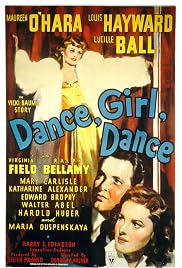
Dance, Girl, Dance (1940), 5

Judy O'Brien is an aspiring ballerina in a dance troupe. Also in the company is Bubbles, a brash mantrap who leaves the struggling troupe for a career in burlesque. When the company ... 
1h 30min | Comedy, Drama, Musical | 30 August 1940 
Directors: Dorothy Arzner, Roy Del Ruth (uncredited)
Stars: Maureen O'Hara, Louis Hayward, Lucille Ball, Ralph Bellamy, Maria Ouspenskaya

http://www.imdb.com/title/tt0032376/
Rented on Google Play with a coupon, excellent print.

I previously rated this 5, meaning "don't watch this again." But without documenting the reasons, that's not too helpful.

It definitely is a music/al, with lots of ballet (some professional), cooch dancing, and G-rated (but tasteless) burlesque singing/dancing.

Lucille Ball plays a hard-hearted dancer who decides being the headliner in burlesque is better than struggling for art. She's mean and unpleasant, and this role is 1/3 of why I don't like the film. Don't get me wrong, LB is very effective in the role. I just don't want to see a movie about this character. This is LB's 49th role of 86 feature films. About 5 films from now we get her paired with Desi in a comedy. Looks friendlier.

I've always liked Maria Ouspenskaya. She plays the teacher/manager of the dance troupe to which LB & MO'H belong. But just when we get to like her, they kill her off. Why? Why clutter the film with a character whose death is meaningless?

I don't remember liking Louis Hayward in anything, and I feel like I always dislike him. Perhaps because he specializes in the type we have here: spoiled, depressed, wealthy, destructive. I've rated 12 movies in his oeuvre, ratings 456666666677, and don't remember any of them. Both of the 7s are non-musical dramas from 1946. I don't own any of the 12 titles. So his character, plus Ouspenskaya's, make another 1/3 of why I don't like the film.

Maureen O'Hara (b. 1920) is luminous. This is her 6th of 55 films. I liked 2 of the previous efforts: Jamaica Inn and The Hunchback of Notre Dame (both '39); neither is a musical. (I haven't seen the other 3.) Her character also chooses burlesque to survive, but she plays the stooge to LB's star. So she performs a little amateur ballet at each show while the men boo her, wanting Lily White (LB) back on stage. She doesn't even get to be comedic. It's pathetic, and even though she gives the audience a piece of her mind one night, I didn't like it. I don't care that a woman directed, and we get some slightly feminist rhetoric in the MO'H speech.

Ralph Bellamy plays the ballet impresario who sees MO'H and sweeps her away to the World of Dance. The End. The powerful man rescues the damsel in distress after all. This and the entire suffering of MO'H is the Last 1/3 accounted for. 

RKO, dir. Arzner & Del Ruth; 5


Friday, January 12, 2018

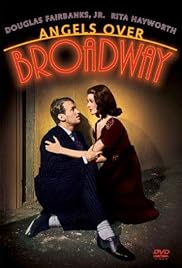
Angels Over Broadway (1940), 6 {nm}

A cuckolded embezzler on the verge of suicide is helped by a tout, an alcoholic playwright, and a pick-up girl to reimburse the money with a gambling sting.
1h 19min || 2 October 1940
Directors: Ben Hecht, Lee Garmes (co-director)
Stars: Douglas Fairbanks Jr., Rita Hayworth, Thomas Mitchell, John Qualen

Genres: Adventure | Comedy | Crime | Drama | Music
http://www.imdb.com/title/tt0032209/
Watched slightly out of sequence to fit the amount of time I had.

NOT a music movie! Submitted deletion to IMDb. I also didn't see any comedy, but I'll let that rest.

Worth watching for RH; her hairline looks slightly higher, but it's not parted in the middle anymore.

I hadn't run into Ben Hecht directing before (he also wrote and produced this one.) He has 7 director credits; this is the 5th. None of the others are familiar titles.

This is fine for its niche, nothing special. Only the 4 top-billed were familiar faces to me. I had previously rated this 6 and concur today.

Columbia, dir. Hecht; 6

Rhythm on the River (1940), 6

Popular songwriter Oliver Courtney has been getting by for years using one ghost writer for his music and another for his lyrics. When both writers meet at an inn, they fall in love and ... 
1h 32min | Comedy, Musical | 6 September 1940
Director: Victor Schertzinger
Stars: Bing Crosby, Mary Martin, Basil Rathbone, Oscar Levant

http://www.imdb.com/title/tt0032986/

Oscar Levant's (b. 1906) 3rd of 14 acting credits, but the 1st two were in 1929. His performance is as you expect from him.

Lots of songs sung. According to Soundtracks page, MM gets 3 solos, BC gets 4, and they have 1 brief duet reprising a BC song at the end. It was very strange seeing both onscreen, 1 singing, and the other not joining in.

Although I've seen him as a composer in Make a Wish (1937), it's strange seeing BR in evening clothes and suits. I expect him either to buckle a swash, or don a deerstalker.

MM's 3rd film, although in the first she only provided a singing voice. She's been on Broadway by now, but seems a little subdued in this movie. Then again, she's playing a lyricist, not a performer.

The film illustrates nicely the problem of a ghostwriter who wants to go public, particularly a composer. When BC tries to get his own song published, he's accused of copying the style of his former employer.

Paramount, dir. Schertzinger; 6