Thursday, February 8, 2018

The Hard Way (1943), 6

Embittered, ambitious Helen Sherman sees an opportunity to escape her drab small-town life by becoming a 'stage mother' to her musically-talented younger sister.
1h 49min | Drama, Musical, Romance | 20 February 1943
Director: Vincent Sherman
Stars: Ida Lupino, Joan Leslie, Dennis Morgan, Jack Carson
LeRoy Prinz ... director: dance numbers / stager: dance numbers

http://www.imdb.com/title/tt0034828/

When this says Drama, this means it. Begins with a suicide attempt, then goes into flashback to explain it. Another film that makes show biz (vaudeville, B'way) seem cruel and grueling.

Joan Leslie (b. 1925) is terrific when her character is young and eager, but not when character is supposed to be tired and jaded. I'm surprised to see how long she's been acting: this is her 20th film, started in '36.

Ida Lupino (b. 1918) is her usual hard-bitten character. Her film credits start in 1931; this is her 33rd.

We get plenty of song/dance, all onstage; it's ok but not great. When JL does a series of cartwheels, her many-layered wide-skirted gown is very distracting; the acrobatics is completely inappropriate to the costume. I wonder how many takes they needed, and if the skirt was modified to be just short enough not to get under her hands on the floor.

Warner, dir. Sherman; 6

Hitler's Children (1943), 6 {nm}

This lurid exposé of the Hitler Youth follows the woes of an American girl declared legally German by the Nazi government.
1h 22min | Drama, Romance | 6 January 1943
Directors: Edward Dmytryk, Irving Reis (uncredited)
Stars: Tim Holt, Bonita Granville, Kent Smith, Otto Kruger

http://www.imdb.com/title/tt0034856/

Not much of an expose of Hitler Youth, really. We see a couple of HY boys at home giving the evil eye to their father, and some scuffles in the schoolyard (American school adjacent to a HY school), but the synopsis overstates the case.

However, the word lurid is apt. BG (b. 1923) chews the scenery as the American girl. I don't know if such things happened: she was living with her German grandparents, going to an American school, and designated because her American parents were of German birth to be taken to a German girl's orientation camp/school. And her American school (first she was a student, but was employed there when seized) couldn't do anything to extricate her.

TH (b. 1919, looking older than his years) plays the boy who scuffled with her in the schoolyard, but grew to be an officer who sent her into Nazi custody. But since he was in love with her, and she's unable to conform to her new environment, he becomes conflicted about his decision. When he recommends her for higher education, and she refuses (she's repulsed by Nazi teachings), this gets both BG and TH in trouble. They are shot during a radio-broadcast trial. The American schoolmaster gets flown to France under threat of being arrested for treason if he doesn't go.

Another juicy detail: they purported that women who held unfit political beliefs would be sterilized. I don't remember that from my reading. But they also talked about women having children for the state, without benefit of marriage, and I do remember that. They mentioned an elderly couple making trouble and being euthanized in a hospital, and certainly euthanizing burdens to society was the start of the development of gas executions.

So this is mostly true propaganda, spun around a semi-attractive couple, one psychologically unhealthy, the other swept into an impossible situation. The title is misleading, since it's not about children, not even about teenagers after the first couple of reels.

RKO, dir. Dmytryk & Reis; 6

Happy Go Lucky (1943), 6 Color

A gold-digger hopes to land a rich husband in Trinidad, but gets mixed up with a beach boy and voodoo.
1h 21min | Comedy, Musical | 4 January 1943 | Color
Director: Curtis Bernhardt
Stars: Mary Martin, Dick Powell, Betty Hutton, Eddie Bracken, Rudy Vallee, Eric Blore.
Paul Oscard ... choreographer / dance director

bootleg, poor print.

DP (b. 1904) hardly qualifies as a beach "boy" as the the synopsis calls him.

Per the Soundtracks, we get 1 MM/DP duet, 2 MM solos, and 2 BH songs. There is some solo and duet dancing, plus some calypso ensemble work. BH has a partner onstage for some athletic swing dancing; he's made up to look old, but is clearly not. Only 1 dancer in the credits, and this is his only film.

The twist to this golddigger story is that DP knows the target (RV), and schemes with MM on how to land him.

The "voodoo" involves a love potion sprayed at the intended.

Eric Blore doesn't get enough screentime for me.

This is the 3rd of 5 pairings of BH & EB, all done within 1942-45.

This is pleasant enough, although it seemed a bit long. Perhaps because of the very poor quality of the print.

Paramount, dir. Bernhardt; 6

You Were Never Lovelier (1942), 8

In Buenos Aires, a man who has decreed that his daughters must marry in order of age allows an American dancer to perform at his club under the condition that he play suitor to his second-oldest daughter.
1h 37min | Comedy, Musical, Romance | 19 November 1942
Director: William A. Seiter
Stars: Fred Astaire, Rita Hayworth, Adolphe Menjou, Xavier Cougat.
Val Raset ... dance director
Fred Astaire ... choreographer (uncredited)
Nicanor Molinare ... choreographer (uncredited)

http://www.imdb.com/title/tt0035583/

In the Tap! Appendix for FA, RH.

This is set in Argentina, and is a remake of a '41 Argentinian non-musical film.

Musical scenes:
  • 3. Chiu Chiu, Cugat band & singers
  • 5. Dearly Beloved, FA sings at wedding
  • 10. Dearly Beloved, RH sings in her room
  • 12. Audition dance, FA dances in AM's office
  • 18. I'm Old Fashioned, RH sings to FA in the garden, then they dance
  • 19. The Shorty George, FA rehearses song/dance to RH, she joins both
  • 21. Ding Dong Dell, Cugat band & singer
  • 23. You Were Never Lovelier, FA sings to RH in garden
  • 26. These Orchids, bellboys sing on delivery
  • 28. You Were Never Lovelier reprise, FA & RH dance again in the garden
The plot is not too convoluted. Amazing that it is again based on the elder daughter must marry before the younger ones. That makes at least 3 this year, just among musicals: Iceland (Fox), Seven Sweethearts (MGM) and this.

Previously rated 7, but the pleasure of their dancing, and his solos, is too great.

Columbia, dir. Seiter; 8

Wednesday, February 7, 2018

Johnny Doughboy (1942), 6-

An arrogant young actress doesn't want to play "young" parts anymore, and runs off. The studio replaces her with the president of her fan club, who just happens to be a lookalike. Meanwhile... 
1h 4min | Adventure, Musical | 31 December 1942
Director: John H. Auer
Stars: Jane Withers, Henry Wilcoxon, Jack Boyle Jr, William Demarest, Ruth Donnelly, Etta McDaniel

http://www.imdb.com/title/tt0034921/
Watched online; mediocre/poor print.

In the Tap! Appendix for JW, and she tapped, but so did many others, including a little girl (10 y.o?) soloing early. JW dances well; unlikely to see her again. 

Bobby Breen's last of 9 films; it's been 3 years since his last starring role. His speaking voice sounds like cartoon chipmunk. He doesn't sing, at least not solo.

All the singing/dancing comes from the rehearsal or performance of a Junior Victory Caravan made up of former child "stars". They couldn't get support to put on their show (USO sort of thing) unless the still-working star, played by JW, also appears. But JW left just as her double appeared, and her manager (not the studio) has the double meet with the Jr. Caravaners. Meanwhile, the real JW ends up at the home of a playwright (HW) in Arrowhead, practicing to be adult, doing athletic things, chaperoned by EMD (Hattie's sister).

It's a pleasant bit of fluff, only tangentially related to the war; it could have been made a year earlier, when we were increasing troop strength, but not yet at war. Somehow it doesn't get too sad that some of these young kids are playing themselves as has-beens. Spanky McFarland and Alfalfa Switzer are there, and others I don't recognize (probably because I don't like kid stars).

Republic, dir. Auer; 6-

Behind the Eight Ball (1942), 5

The members of a summer theater group get mixed up with spies and murder.
1h | Comedy, Musical, Mystery, Romance | 4 December 1942
Director: Edward F. Cline
Stars: Al Ritz, Jimmy Ritz, Harry Ritz, William Demarest.
Eddie Prinz ... choreographer

http://www.imdb.com/title/tt0034500/
Watched online part 1part 2, mediocre print. Runtime was 1:09

In the Tap! Appendix for Johnny Downs, Grace McDonald, Ritz Brothers. OK, I'll sign off on their dancing being "tap." But tap sounds were not provided.

Whodunit? A guest clarinetist. Why? Something about the barn's prior use as a ... dunno, some kind of sabotagey thing. And two shots were fired: one from the stage, one from...? So who was the second shooter? Argh.

Songs ok, dancing pretty good, but the plot completely corrupted/distracted from the proceedings. Why would someone need to kill random performers to reclaim a barn? Just move your equipment. Or make loud noises during the performances to ruin the venue?

If you want to see the Ritz Bros dance here, it's toward the end of the film, after the 1st hour. Actually, all the dancing is pretty good (but not "worthwhile"), so just skip past all the non-dancing scenes. (The comedy is skippable too.)

Universal, dir. Cline; 5

Seven Days' Leave (1942), 5

Soldier Johnny Grey is engaged to marry singer Mapy Cortes, but his plans go awry when he learns that he is the heir to $100,000 from his great-grandfather -- a bequest that comes with a ... 
1h 27min | Comedy, Musical, Romance | 13 November 1942
Director: Tim Whelan
Stars: Victor Mature, Lucille Ball, Harold Peary
Charles Walters ... dance ensembles

Watched online, poor copy.

VM has a badly-matched voice double; he moves around a lot in places, but is it really dancing?

We get some good big-band music, and decent ensemble dancing. But the energy, the acting and the looks of VM really put me off. If this had been Franchot Tone, or anyone less overbearing, I might have found the story more interesting. (VM is heir to a modest fortune, but the will has a codicil requiring him to marry the descendant of a rival family. The only candidate, LB, has money of her own, so he feels he must romance her to get the wedding. But she's already engaged, with a wedding date nearby.) LB's mind flipflops very readily about whether she's loyal to her betrothed or attracted to the hulk. No possible ending here is happy, although I suspect VM fans would disagree.

This is Charles Walters' (b. 1911) first adult film credit (he had a "child" actor credit in 1924). He dances on film a few times, has 22 choreography credits and 24 director credits. I remember a moment where he dances with Judy Garland that impressed me in Presenting Lily Mars ('43), and noticed his name as director in my collection before starting this quest. (It's probably a good sign that he makes at least 2 films with most stars.)

There is sort of a backdrop of the war: VM & pals are soldiers trying to accomplish his goals on a 1-week furlough. The end shows a LOT of men in various uniforms sailing away to war. Buy Bonds.


RKO, dir. Whelan; 5

Seven Sweethearts (1942), 6-

Covering the tulip festival in Little Delft, Michigan, reporter Henry Taggart takes a room at an inn ran by an eccentric old Dutchman, Mr. Van Maaster and his seven daughters. The eldest, ... 
1h 38min | Musical, Romance | 13 November 1942
Director: Frank Borzage
Stars: Kathryn Grayson, Marsha Hunt, Van Heflin, S.Z. Sakall.
Ernst Matray ... dance director

Watched online part 1, part 2, ok print.

KG's 4th film, 1st on this quest. She sings plenty, and she has some terrific high notes. She can act, but I've never warmed to her. I have a dozen of her 21 movies, but each for a reason other than her.

This is a sweet film, with a basic conflict: the eldest daughter was raised to be a brat (while the other 6 are obedient) and she wants to be in show biz in NYC. But it's not terribly interesting, and has a surprise ending with the eldest (or maybe I didn't pay good attention.)

At the tulip festival we get a large folk dance (with girls dancing both genders) in traditional Dutch costumes and clunky wooden shoe noises (not many feet shown), filmed mostly as a sequence of close-ups. Very unsatisfactory.

I have no idea why VH & KG fall in love. He's unattractive physically, and has an unpleasant personality. Plus KG is the youngest, most loyal sister, so it's not like she's yearning to leave town.

Cuddles Sakall is the best thing about the show, and you can watch him elsewhere.

I'll stop short of giving this a 5 because I dozed off and had to restart, but it might deserve it.

MGM, dir. Borzage; 6-

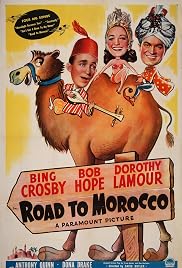
Road to Morocco (1942), 7-

Two carefree castaways on a desert shore find an Arabian Nights city, where they compete for the luscious Princess Shalmar.
1h 22min || 10 November 1942
Director: David Butler
Stars: Bing Crosby, Bob Hope, Dorothy Lamour, Anthony Quinn, Dona Drake.
Paul Oscard ... dances stager

Genres: Adventure | Comedy | Family | Musical | Romance

Home to my favorite of the Road songs, primarily for the references to Morocco leather-bound books. Also here: Moonlight Becomes You and 2 more songs. We get harem-girls dancing, and a specialty with sword-dancers. 

Dona Drake neither sings nor dances, but energetically pursues BH for romance. AQ is  appropriately menacing as the leader of a tribe that violently robs others, and yet he is to marry the princess. The boys do the patty-cake for him.

It's fun and frothy, with very pretty clothes and sets, songs and dance, and no real reference to the war. (They are adrift at the beginning of the film because BH had entered a Powder Room with a lit cigarette, and the ship blew  up.)

Paramount, dir. Butler; 7-

The Yanks Are Coming (1942), 6-

Bandleader alienates crooner, songwriter/arranger and band members, both in their music work, and in his attitude about service to country during wartime.
1h 5min | Comedy, Musical, Romance | 9 November 1942
Director: Alexis Thurn-Taxis
Stars: Henry King, Mary Healy, Jack Heller

watched online, mediocre copy.

Look at the initials of the studio: PRC (and that's what they show onscreen). Is this where the nickname Poverty Row came from, or did they name the company to mock it?

I only recognize Maxie Rosenbloom (a real-life former boxer), playing a former boxer.

This is a blatant propaganda film to stir up the populace for war. Here are the 4 of the 5 song titles, all written by 2 composers + 2 lyricists, and the composers were the storywriters for the film:
  • The Yanks Are Coming 
  • I Must Have Priorities On Your Love (referring to priorities set on resources for war production/ support of armed forces)
  • There Will Be No Blackout Of Democracy (blackouts as a precaution against air raids)
  • Zip Your Lip (don't share information about the military, don't spread rumors)
The songs are pretty good. Not Rodgers and Hart good, but ok. They are dead on-point, but why not?

The refreshing thing here, likely only "refreshing" because I'm watching in time sequence, is that one of the characters objects to being recruited. He only wants to serve if he can be at least a captain, and goes so far as to propose that to the authorities. (He can avoid the draft because his elder brother is already serving.) The weakness of the story is that he changes his mind, and his personality, rather suddenly. We see an event that disrupts him, but don't really get a clue why it turns him in the direction it does.

If asked to recommend movies to show the attitudes about the war, I'd include this. But as a film, it's not great, and likely there's no good print publicly available.

Producers Releasing Corporation (PRC), dir. Thurn-Taxis; 6-

Springtime in the Rockies (1942), 6+ Color

Broadway partners Vicky Lane and Dan Christy have a tiff over Christy's womanizing. Jealous Vicky takes up with her old flame and former dance partner, Victor Price, and Dan's career takes ... 
1h 31min | Musical | 6 November 1942
Director: Irving Cummings
Stars: Betty Grable, Carmen Miranda, John Payne, Cesar Romero, Charlotte Greenwood, Edward Everett Horton, Harry James.
Hermes Pan ... choreographer

bootleg, poor print.

To be honest, I was drowsy while watching this, so I can't be certain, but I think this was a war-free film, could have been made a year earlier, but IMDb says production was 15 June 1942 - 10 August 1942.

This film definitely disproves my theory that BG can't partner-dance. That's almost all she does here, with Cesar Romero, and they are excellent together. He does more legwork than usual, keeping up with her. But they never missed a hand-meet. This is his specialty (ballroom), and he took the lead well.

JP sings with BG, and looks awkward even swaying to the music.

CM does indeed wear 2 black/white outfits here, plus at least 4 with vibrant colors, especially green/aqua. She also dance a bit with CR, and romances EEH. 

CG (b. 1890) does her rubber-hipped kicks, and her hand+feet "crawl", plus her flat-on-the-floor splits. She also eyes EEH.

We also get some big ensemble work in vibrant colors. In the Tap! Appendix for BG, and she does tap. I should get the official release.

The plot is all show biz (B'way) and romance. And we get some Harry James music. (He & BG marry in mid-'43. She's been divorced since '40.)

Fox, dir. Cummings; 6+

Tuesday, February 6, 2018

Once Upon a Honeymoon (1942), 7+ {nm}

In Europe at the start of World War II, a woman notices that wherever her husband goes, the Nazis seem to follow. Meanwhile, a charming reporter is following them.
1h 57min || 27 November 1942
Director: Leo McCarey
Stars: Ginger Rogers, Cary Grant, Walter Slezak, Albert Dekker

Genres: Adventure | Comedy | Drama | Mystery | Romance | War
http://www.imdb.com/title/tt0035151/

Fun and informative, if you don't mind your facts vague.

The synopsis is misleading. The Nazis are "following" her husband the baron in the sense that each country he visits is overtaken. He seems to be the negotiator who paves the path with the head of state in Austria and in Norway (he's shown meeting with Quisling), and Poland is shown bombed to bits while they're there.

This is another terrific propaganda film, showing that Germany took over Austria, Czechoslovakia, Poland, Denmark, Norway, Holland, Belgium and France (I didn't see Luxembourg). They personalized it by having a Jewish hotel maid with 2 children in Poland impress the baroness (GR) sufficiently that she helps them escape. At one point CG & GR are caught with only a Jewish passport, and are taken to a holding camp (made to look very unpleasant).

There's more to the plot that I hope to forget so I can enjoy this again. Amazingly, this does retain a comedic touch, while being serious when needed. The stars are superb in their straddling of that dramedy seesaw, and it's delightful to look at them.

RKO, dir. McCarey; 7+

For Me and My Gal (1942), 7

Two vaudeville performers fall in love, but find their relationship tested by the arrival of WWI.
1h 44min | Musical, Romance, War | 21 October 1942
Director: Busby Berkeley
Stars: Judy Garland, George Murphy, Gene Kelly, Ben Blue, Keenan Wynn.
Bobby Connolly ... dance director


Previously rated 8 on 2 Jan 2006 with 150 other ratings; a dozen are 6's, one 5, the rest 7-9. Looks like all are titles I own (now). Had only ~25 ratings prior to this batch.

In the Tap! Appendix for JG, GM, GK. GM doesn't get much dancing time. He does his best acting (in this quest) when JG describes the pain of her unrequited love for GK, and he empathizes because he has the same problem with her.

This is GK's first film, where he plays a heel redeemed. He was fresh from Broadway in Pal Joey, playing a heel. (He does play arrogant & self-centered well.)

Numbers with at least one of the 3 stars:

  • sc3: GK does a clown-makeup dance
  • sc4: Oh, You Beautiful Doll, GM, JG dancing
  • sc5: By the Beautiful Sea, GM, JG dancing
  • sc8: For Me and My Gal, JG, GK "spontaneous" in restaurant
  • sc10: When You Wore a Tulip, JG, GK onstage dancing
  • sc14: After You've Gone, JG torch song
  • sc19: Tell Me, Till We Meet Again
  • sc21: Ballin' the Jack, sung/danced by GK, JG in hose and fancy shorts (scene-stealer)
  • ?? Goodbye Broadway, Hello France; Oh, Frenchy, GK, BB dance
  • sc27: How Ya Gonna Keep 'Em Down on the Farm?, JG
  • sc29: Where Do We Go from Here?, JG
  • sc30: Tipperary medley, JG
  • sc32: 
    • When Johnny Comes Marching Home, JG
    • For Me and My Gal (brief reprise), not really danced by JG, GK
When GK does his aeroplane spin-step, I had to roll my eyes. I'm betting he does it in every movie from here to An American in Paris ('51), with any exceptions being anthology films like The Ziegfeld Follies ('45). (I use the archaic spelling of aeroplane because GK names it that in An American in Paris, when teaching some French children on the street a few dance steps.) When JG does it with him, hers doesn't look right. Maybe it's hard to do.

I wonder if I over-rated the film before, or if my perspective is altered now by this thought: GK arriving is the beginning of the end of the movie musical. When he quits in the mid-50's, musicals evaporate shortly thereafter. Did he take them to such a high level, that no one could match his work? Did the shift from big band to rock'n'roll change audience preferences? Or was TV so prevalent that only teenagers wanted to leave the house? Probably all of the above, with a heavy dose of the studio system being gutted in '48 when they were forced to divest themselves of distribution and exhibition divisions.

All the dancing is onstage (except the restaurant scene, which is an even smaller space), and camera use is dull. According to the Soundtracks, only 1 song was written after 1923 (The Doll Shop, by Roger Edens). So this isn't my favorite music, and the dancing did not dazzle.

The plot is tough and the characters aren't psychologically healthy. The WW1 setting is clearly meant as propaganda to increase enthusiasm for our involvement in WW2, with JG condemning GK for avoiding the draft immediately after her brother is killed.

JG & GK do have chemistry together, especially when singing and dancing. The harmony they use in the title song is especially good, he singing higher than she. It's one situation where the thin nature of his voice is an asset.

MGM, dir. Berkeley, 7

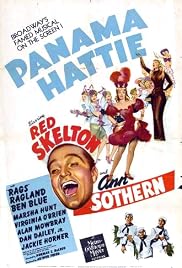
Panama Hattie (1942), 6+

Hattie Maloney runs a saloon in Panama where assorted characters congregate where they frequently sing and dance Cole Porter numbers. An upper class gentleman arrives and sparks fly between... 
1h 19min | Comedy, Musical | September 1942
Directors: Norman Z. McLeod, Roy Del Ruth (uncredited), Vincente Minnelli
Stars: Red Skelton, Ann Sothern, Rags Ragland, Dan Dailey, Marsha Hunt, Alan Mowbry.
Daniel Dare ... dance director (as Danny Dare)
Vincente Minnelli ... stager: musical numbers

http://www.imdb.com/title/tt0035170/
bootleg, mediocre copy. should get official release.

In the Tap! Appendix for Berry Brothers, Dan Dailey. Ffwd'd to confirm DD does NOT dance. BB dance twice. Their first number concludes with them leaping over a railing on the second level (club entrance) into splits on the floor below, sliding up to standing position and catching the canes thrown to them - spectacular. Lena Horne sings twice, one is Just One of Those Things, but it's too brief. AS has 1 solo and another song with 3 cast mates. Skelton, Ragland & Blue have a number with 3 women. Some of the songs come from Cole Porter, others from Roger Edens. This is an Arthur Freed production.

The plot is not great, based entirely on the class difference between AS and DD (Philadelphia society, but DD's not convincing) who has an 8-y.o. daughter. The daughter, who looks younger, laughs at the outfit AS dons to meet her, and later advises her on her 2nd outfit, cutting off its bows. AM is the butler who escorts the daughter to Panama. MH is a society acquaintance of DD who also denigrates AS.

This is thoroughly infused with the war. Skelton, Ragland & Blue are sailors, DD is army (4 stripes), MH is an admiral's daughter. The cast sings a big patriotic song to the 4th wall at the end.

MGM, dir. McLeod, Del Ruth, Minnelli; 6+

Iceland (1942), 7-

Marine, James Murfin, is unaware of Icelandic customs. When he flirts with Katina her Icelandic family take his actions as a proposal of marriage to Katina. Desperately wanting out, James ... 
1h 19min | Musical, Romance | 21 September 1942
Director: H. Bruce Humberstone
Stars: Sonja Henie, John Payne, Jack Oakie.
James Gonzalez ... skating ensembles (as James Gonzales)
Hermes Pan ... choreographer (uncredited)
Kenny Williams ... assistant dance director (uncredited)

http://www.imdb.com/title/tt0034886/
bootleg, mediocre copy; should buy an official release.

SH plays a woman who lies very readily, often to get out of an inconvenient situation, which is often caused by her lies. But she  seems sweet nonetheless.

She has 3 skating segments and some folk dancing:

  • 19 min: SH "casual" skating with others not choreographed, lasting < 1 min
  • 25 min: folk dancing to nudge the boy to propose to the girl, with JP & SH as the boy & girl
  • 29 min: a show with multiple skating segments and lots of skaters
    • China Sea, big ensemble precedes SH, they watch on sideline while she skates solo
    • Panama, no ensemble, new costume, ice dance only with a partner (Eugene Turner), beautifully coordinated ballroom-style with big use of rink; impressive how well they join hands after each separation
    • Hawaiian medley, new costume, starting with SH solo, lovely hula hands while skating, then big ensemble with her
  • 68 min: ensemble couples skate to the folkdance song at sister's wedding
  • 75 min: SH & ensemble in military-style costumes, she skates to US marching music, joined by ensemble who do some drill routines, then she solos again. (This feels like the 4th segment of the earlier production.)

We also get 4 numbers of big band fronted by a singer (Joan Merrill), which could easily have been filmed with the cast elsewhere (with one exception). Unless I'm forgetting something, JP did not sing.

I cannot imagine how this plot would be adapted for today's morality. This all hinges on the tradition that the older daughter must wed before the younger, and the improprieties of not being alone in a locked room with a man not your husband.

This has enough skating, and enough charm from the 3 top-billed, that I like it.

Fox, dir. Humberstone; 7-

Monday, February 5, 2018

Broken Strings (1942), 5-

After noted violinist Arthur Williams suffers a hand injury which ends his playing career, his hopes are transferred to his son, who prefers swing music to classical.
1h | Drama, Music | 7 October 1942
Director: Bernard B. Ray
Stars: Clarence Muse, Sybil Lewis, William Washington

http://www.imdb.com/title/tt0135173/
Watched online; dark, blurry.

On 31 May 2014 I watched five films, three 6s and two 7s. I have no idea why this was a 7. Makes me wonder if I watched something else and rated this accidentally.

This is typical of race films I've watched: dull script/sets, bad/mediocre acting/direction, and the painful silence between songs like films of the early 30s.

I was hoping for more from Clarence Muse. The problems portrayed here are those of the middle-class, as usual for race films (but atypical of his roles in mainstream films). This is the teen years of The Jazz Singer, but for violin not voice.  CM plays a rightfully bitter man who is cruel to his child and his students, and experiences a miraculous cure out of nowhere to finish the film.

The song most frequently played is Humoresque, which I dislike. I don't want to watch CM's character, I don't care what happens to him, and I wince for his victims. I'll stop short of calling this a 4, but I hope I don't watch it again; or if I do, that my reaction is better.

Goldport Productions, L.C. Borden Productions, dir. Ray; 5-

Get Hep to Love (1942), 5

Orphan prodigy singer runs away from her oppressive aunt and tricks a rural couple into adopting her.
1h 11min | Drama, Musical | 2 October 1942
Director: Charles Lamont
Stars: Gloria Jean, Donald O'Connor, Jane Frazee

http://www.imdb.com/title/tt0034784/
Watched online; dark blurry print.

In the Tap! Appendix for Jivin' Jacks and Jills, Donald O'Connor, Peggy Ryan. I'm reasonably certain DO did not dance; there was only 1 scene where the JJ&J danced, and PR had a big solo with singing, and DO arrived at the joint after they were done. At the prom he does a little social dancing, no showboating.

Gloria Jean sings plenty, Tommy Rall was one of the JJ&J, but I'm taking this off my wishlist.

Universal, dir. Lamont; 5

Orchestra Wives (1942), 7+

Connie Ward is in seventh heaven when Gene Morrison's band rolls into town. She is swept off her feet by trumpeter Bill Abbot. After marrying him, she joins the bands tour and learns about ... 
1h 38min | Drama, Musical, Romance | 4 September 1942
Director: Archie Mayo
Stars: George Montgomery, Ann Rutherford, Glenn Miller, Lynn Bari, Carole Landis, Cesar Romero.
Nick Castle ... dances stager: Nicholas Brothers


The plot and the stars are skippable. But the music, and the finale with the NB dancing up the wall, where Harold somersaults and lands in a split, these are strong enough to recommend the film. According to commentary track, this was Nick Castle's idea. They trained Harold with ropes around his waist, eventually decided he was ready to solo, and only loosely held the ropes without telling him first. (No mention of Cagney's jumping up the wall in Yankee Doodle Dandy in June. No production dates in IMDb.) In the Tap! Appendix for NB.

Betty Hutton's sister Marion is one of 2 female vocalists for the band (she sings with the Modernaires), and when she starts hamming up the lyrics, she looks and gestures just like her sister. But most of the time she looks placid, and is more beautiful than BH.

Lynn Bari, although she sings, is dubbed here with a voice that nicely matches her own. Instead she plays the conniving b!tch who tries to undo GM's new marriage to AR to win him back, with some help from Carole Landis, who just connives for sport.

Cesar Romero does not dance here, and has limited screen time. Although he plays a womanizing heel, we never see him score. And he gets to play good guy at the end, helping AR and the band.

Songs:
  • sc1: Moonlight Serenade, making the Glenn Miller title card redundant
  • sc2: Chattanooga Choo-Choo, just played as a warm-up
  • sc3: People Like You and Me
  • sc6: At Last
  • sc9: Bugle Call Rag; these lyrics are the only mention of the war, and promote service
  • sc16: Serenade in Blue
  • sc26: I've Got a Gal in Kalamazoo
  • sc27: NB sing & dance to ...Kalamazoo
In the commentary track, AR (1917-2012) & Fayard Nicholas (1914-2006) say they are recording it 63 years after the film, which makes it 2005, the year of the dvd release. The track is as you would expect, given that they didn't interact in the film; they do sound like they were in the same room and interacting during the recording. They bring only personal memories of the film and other things. (AR talks about her youth, her start in radio, her favorite hamburger stand - the first Carl's, all in the Wilshire district.)

Fox, dir. Mayo; 7+

Cairo (1942), 7+

Reporter Homer Smith accidently draws Marcia Warren into his mission to stop Nazis from bombing Allied Conwoys with robot-planes.
1h 41min | Comedy, Drama, Musical, Romance | 17 August 1942
Director: W.S. Van Dyke (as Maj. W.S. Van Dyke II)
Stars: Jeanette MacDonald, Robert Young, Ethel Waters.
Sammy Lee ... dance director


In order to understand my prior rating of 6, I did some research. I rated it on 24 Jul 2014 with 4 other films, so this is likely my watching and rating the film immediately after. It was the 5th film rated that day, and none of the others are focused on the War: Conflict (1945; 6), Brother Orchid (1940; 7), The Bride Goes Wild (1948; 5), Cass Timberlane (1947; 5). (I only own 2 of these, likely bought after viewing, this one to be a completist for JM.)

I was keeping a log of books read while doing my WW2 research, which I didn't begin until Sep 2014. So I didn't yet view this from that perspective. 

As a musical, it's not great: not enough music. JM sings well, just not enough. Fortunately Ethel Waters gets to sing (she did NOT in Tales of Manhattan earlier this year), and she has THREE such scenes, although only 1 where she solos (~1:14; pre-Casablanca (11'42) Dooley Wilson watches admiringly, and reprises the song with her; their scene lasts until ~1:20, and it's completely excisable). I don't see enough dancing to require a dance director (I even ffwd'd through the whole thing, and only saw some acrobatics at the carnival).

But as a comedic war/spy thriller, this is pretty good. And merge the 2 together, and it adds to 7. As propaganda, it's also good: the woman Nazi gives a chilling explanation of why she's willing to give her life for the "cause," and immediately hurls racial condemnations at the Arab who is providing the remote bomber plane technology to them.

The synopsis above is bad. RY's drawing JM into his investigation (he's a reporter, not a government agent) is only accidental in the sense that she is somewhat randomly identified as an enemy agent, and the conVoy of troups (as well as the Suez canal) was the target of the remote-controlled bomb-laden planes.

MGM, dir. Van Dyke; 7+

Sunday, February 4, 2018

Pardon My Sarong (1942), 6

A pair of bus drivers accidentally steal their own bus. With the company issuing a warrant for their arrest, they tag along with a playboy on a boat trip that finds them on a tropical island, where a jewel thief has sinister plans for them.
1h 24min | Comedy, Musical, Adventure | 7 August 1942
Director: Erle C. Kenton
Stars: Bud Abbott, Lou Costello, Virginia Bruce, William Demarest.
Katherine Dunham ... dances originated by / dances staged by


In the Tap! Appendix for Tip, Tap and Toe, who have a lengthy routine during the Ink Spots their second song Shout, Brother, Shout (written by Clarence Williams) at ~21min (dance 22:30-25:30). TT&T consist of Samuel Green (Tip), Ted Fraser (Tap) and Ray Winfield (Toe). This is the 2nd of their 4 film credits.

Soundtracks says the Ink Spots also sing Java Jive, but I don't know where that happens.

The dancing staged by Dunham must have been the "natives" on the uncharted island with the tall mountain volcano. The dancing is very swingy without feeling like the natives should be wearing modern clothes.

The movie could almost be scavenged for parts. The first part is a bus ride that could have inspired Speed (1994). Once they reach their destination, we spend time at a yacht club where they elude a cop (WD) who wants them for stealing the bus. Then they struggle with the sea as the ignorant crew of a yacht. They sail off course to the tropical isle, finding a criminal gang and cannibals (or maybe they just think so?) In addition to the volcano, we get African animals: crocodile, zebra and lions. Then they enter a native temple with life-size statues of warriors, one of whom moves slightly, but they never come to life. And the bad guys are there to steal the native's totem for safety: a beautifully cut and mounted enormous ruby. It's like the story planners drew plot elements out of a hat. I feel lucky that Frankenstein didn't show up. (The jewel was not on LC's neck toward the end of the film; not sure what happened to it.)

Glad to see TT&T's routine, to hear the Ink Spots, and watch Dunham's dance design. But the comedy was all over the place.

Universal, dir. Kenton; 6

The Big Street (1942), 6

Little Pinks is in love with a nightclub singer named Gloria. But it is a unrequited love as she does not know that he exists. Pinks is a shy busboy and Gloria only goes out with men who ... 
1h 28min | Drama, Music, Romance | 4 September 1942
Director: Irving Reis
Stars: Henry Fonda, Lucille Ball, Barton MacLane, Eugene Pallette, Agnes Morehead.
Chester Hale ... dance director

http://www.imdb.com/title/tt0034514/
Watched online; poor print.

Previously rated 5; I remember hating how LB treated HF. Still do, but there's more here. Eventually HF's devotion transcends infatuation without becoming falsely noble. And he does have a breaking point. The ending provides relief for all.

This is a 1-song Music film. LB (dubbed) sings it near the beginning and near the end. I don't remember any dancing other than social.

Always a pleasure to see E.Pallette (at his largest here), and Agnes Morehead is welcome too. And just to make us feel like the Mercury Theatre troupe is still employed at RKO (Citizen Kane was '41), Ray Collins has a prominent role as well.

RKO, dir. Reis; 6

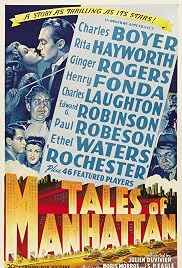
Tales of Manhattan (1942), 6+ {nm}


A formal tailcoat that gets passed from one owner to another affects each life in a significant way.
1h 58min | Comedy, Drama, Romance | 24 September 1942
Director: Julien Duvivier
Stars: see below

http://www.imdb.com/title/tt0035415/
bootleg; ok print

Added to the quest because of Robeson, who sings. No one dances.

The Laughton/Lanchester story is very effective both because of their performances and the writing. And the Robeson/Waters sequence is a pleasure, mostly because he (but not she) sings with the Hall Johnson Choir.

Anthology. Stars by story (thanks to IMDb reviewer Ron Oliver, 26 June 2004, "Check The Pockets For Fine Entertainment"):

  1. Charles Boyer, Rita Hayworth, Thomas Mitchell, Eugene Palette, Robert Greig 
  2. Henry Fonda, Cesar Romero, Ginger Rogers, Gail Patrick, Roland Young 
  3. Charles Laughton, Elsa Lanchester
  4. Edward G. Robinson, James Gleason, Harry Davenport, George Sanders 
  5. W.C. Fields, Phil Silvers, Marcel Dalio, Margaret Dumont
  6. J. Carrol Naish, Paul Robeson, Ethel Waters, Eddie 'Rochester' Anderson, Clarence Muse, Hall Johnson Choir
Fox, dir. Duvivier; 6+

Saturday, February 3, 2018

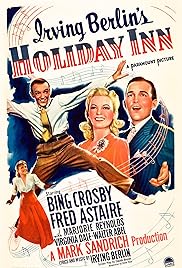
Holiday Inn (1942), 8-

At an inn which is only open on holidays, a crooner and a hoofer vie for the affections of a beautiful up-and-coming performer.
1h 40min | Comedy, Drama, Musical | 4 September 1942
Director: Mark Sandrich
Stars: Bing Crosby, Fred Astaire, Marjorie Reynolds.
Daniel Dare ... dance ensembles staged by (as Danny Dare)
George King ... assistant dance director (uncredited)
Sam Ledner ... dance director (uncredited)
Al Mann         ... dance assistant (uncredited)
Hazel Noe ... dance secretary (uncredited)
Babe Pearce ... assistant dance director (uncredited)


An Irving Berlin songfest, including White Christmas, Happy Holiday, Easter Parade and Holiday Inn; 17 songs/medleys in toto.

This is the home of FA dancing solo with firecrackers. He has 3+ numbers with MR (the + is a medley/montage), 1+ with Virginia Dale (the + is the finale), and the opener with BC & VD (although it's mostly singing.) In the Tap! Appendix for FA, MR, VD.

BC, MR and onstage band perform Abraham (re: Lincoln) in blackface (supposedly to hide her from FA). The rest of the songs are sung without dance.

Both women look fine dancing with FA, but nothing I'd want to see in another film, and H'wood agreed. Per the dvd's Production Notes, both women were cast at the last minute, since all the preferred partners (Ginger R, Rita H, Eleanor P & Mary Martin) were committed elsewhere. (Also in the PN: the motel chain Holiday Inn was founded in '52, named after the film. Wikipedia says the name was a joke that stuck.)

Because both romances are triangular rivalries, this is less enjoyable than when one man pursues one woman. If rating it today, I'd probably land on 7, if only for the firecracker dance. It may be that I hadn't seen many BC movies when I rated this; I own a lot of them now. Hmm... I rated this on the same day as 11 other favorite movies in the early days of my IMDb membership, so I was likely trying to generate some recommendations. But I'll keep the prior rating for now.

Paramount, dir. Sandrich; 8-

Footlight Serenade (1942), 6

A boxing champ gets involved with a Broadway show and a shapely chorine...who's engaged to his new sparring partner.
1h 20min | Comedy, Musical, Romance | 1 August 1942
Director: Gregory Ratoff
Stars: John Payne, Betty Grable, Victor Mature, Jane Wyman, James Gleason, Phil Silvers.
Hermes Pan ... dance director
Angela Blue ... assistant choreographer (uncredited)

bootleg, decent copy.

Very poor title. Footlight Footwork would be better, since the finale here is a boxing match between JP & VM. 

BG sings/dances an audition, we get a number danced by BG & HP, in rehearsal clothes, subbing for both intended dancers, just to see how the routine is shaping up, and a third dance with BG & chorus, then her shadow (which spars with her). Soundtracks also lists a BG/JP duet. In the Tap! Appendix for BG & HP.

The film totally lacks glamour, since all completed musical numbers are rehearsal only.

Of course, I don't like VM, so that colors my rating. If the role were played by Robert Ryan (who has no credits in '41-'42), or Cesar Romero, maybe Anthony Quinn, or just about anyone else who could pass for a boxer with song/dance ambitions, I would probably like this better.

Fox, dir. Ratoff; 6

Maisie Gets Her Man (1942), 7- {nm}


Parting company with her on-stage partner Professor Orco partly due to the job being potentially hazardous to her health, streetwise but kind-hearted vaudeville performer Maisie Ravier, in ... 
1h 26min | Comedy, Romance | June 1942
Director: Roy Del Ruth
Stars: Ann Sothern, Red Skelton, Leo Gorcey.
Daniel Dare ... dance director


Truly not a musical, although other films have been tagged as such with about the same music content.

I find it bizarre that none of the Maisie movies are Musicals, especially since her profession is singer/showgirl (although she has various jobs along the way.) But given this is in the Tap! Appendix for uncredited white and black tap dancers, I'll watch this now. Also on AFI's list of 500 films nominated for Top 100 Funniest, and previously rated 7 by me (only one other of the ten Maisie films also got a 7).

The Tap! author was optimistic about the tapping content here. In the opening scene, while Maisie is on the phone, we see a black soloist at a distance, on stage tapping and doing the splits in formal wear; but we spend more time off the dancer than on, and hear only the music. In the final scene, Maisie fronts some chorus girls, but they are strutting/wiggling, not really tapping.

This is entertaining enough, but I don't know why it gets the AFI nom, nor why I gave this a 7. Red Skelton is charming in his usual sweet way. Maisie is bravely self-reliant and warm-hearted; a watchable character who deserved her 10-film series. I won't change my rating, but would only give it a 6+ today.

MGM, dir. Del Ruth; 7-

I Married an Angel (1942), 6+

Anna Zador is a secretary who's been working for 6 years at Count Willie Palaffi's bank. Every day, she rides to work on her bike and places flowers on Willie's desk, but Willie (the ... 
1h 24min | Fantasy, Musical, Romance, Comedy | 9 July 1942
Directors: W.S. Van Dyke (as Maj. W.S. Van Dyke II), Roy Del Ruth (uncredited)
Stars: Jeanette MacDonald, Nelson Eddy, Edward Everett Horton
Ernst Matray ... dance director (as Ernest Matray)
Jeni Le Gon ... dance coach: "A Twinkle In Your Eye" boogie woogie dance (uncredited)


Adapted from the 1938 Rodgers & Hart stage musical with 5 of their songs, plus 2 more 1942 songs by Rodgers, and 6 by Stothart, and some classical arias are listed on the Soundtracks page.

One of my favorite moments is JM & Binnie Barnes doing the boogie woogie dance coached by Jeni Le Gon at about 70 min. JM is especially good at it.

The fantastic nature of the film, with JM in the second role as angel Brigita, is pointed out several times when we get brief cuts to NE on his couch sleeping, often fitfully to mirror the action in the dream.

The last scene of the dream has JM dancing/singing a hula. I wonder if that was part of the original play, or if we get more Hawaiian sequences/references after Dec 7.

Anne Jeffries is listed in IMDb's onscreen credits as Polly; confirmed that she's listed in the after-movie title card. I could not find her, even after looking at a photo from a 1943 film where she looks like herself, albeit younger.

The title song is repeated often, and the one bar of the title itself gets to be grating. Elsewhere (perhaps the same song), there is a brief sequence of notes that reminds me of Lady in the Dark, a  musical debuting on B'way somewhat later than this film's antecedent.

This film also reminds me of the film Love Me Tonight ('32), especially when one of the Paris couturiers here is an actor (composer in a taxi) from the early sequence passing Isn't It Romantic around town in LMT. Both films are Rodgers & Hart, but other R&H films in between have not reminded me of LMT. The more bizarre reaction: I felt that this one was too stuffy, and then realized JM was in both. Which means the stuffiness is either part of the acting/directing, or needs to be pinned to NE (b. 1901). And Maurice Chevalier (b. 1888) would have filled NE's playboy Count role well. (MC has no IMDb actor credits from 1939-47, and I believe he was in France during the war.)

Really tough to decide between 6 & 7. We have a lot of music, it's a fantasy, which I think is an especially good companion to the Musical genre, but it's somehow too reserved (stuffy)/dignified.

MGM, dir. Van Dyke & Del Ruth; 6+

Primer (2004), 5 {nm}

Four friends/fledgling entrepreneurs, knowing that there's something bigger and more innovative than the different error-checking devices they've built, wrestle over their new invention.
1h 17min | Drama, Sci-Fi, Thriller | 16 January 2004 (Sundance Film Festival)
Director & writer: Shane Carruth
Stars: Shane Carruth, David Sullivan, Casey Gooden

http://www.imdb.com/title/tt0390384/

The film spends a lot of time on technical things, as though it's going to explain how time travel works. That is such a huge distraction, that _I_ lost WHAT they were doing.

The basic idea seems to be that these guys go BACK in time and use information they know about sports and stocks to make money. (I emphasize back because the discovery of time alteration was the ACCELERATION of fungus protein output, meaning a FORWARD movement in time. And all the cr@p about 1300 cycles, A-B and parabolas only obscured things further.)

But to execute these bets/trades, they have to sit in a hotel room for 6 hours, so they don't interact with their past selves or others they know. I didn't follow why 6 hours, and who cares.

The only value to the film is the idea of the corruption that occurs when you can start asserting control over past events: absolute power corrupts absolutely. But even that is not presented well. We get a sliver of a discussion of supposedly hypothetical with the wife, but she can't be bothered. Between the 2 time travelers, who actually start encountering real decisions, we don't get much meaningful talk about the ethics involved.

I watched this twice, listened to part of the director's commentary (and he was speaking as director, not much as the writer), and read some online stuff about the movie.

It's possible that I'm not enough of a connoisseur of time-travel stories to appreciate what's presented, but I don't feel this provides much that's worthy of discussion unless you generalize to  "the ethics of time travel." I was at least hoping to be entertained. I got curious for a while, saw the wool over my eyes, and decided to move on.

Indie, dir. Carruth; 5

Friday, February 2, 2018

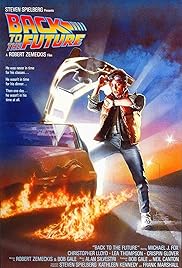
Back to the Future (1985), 6+ {nm}

Marty McFly, a 17-year-old high school student, is accidentally sent thirty years into the past in a time-traveling DeLorean invented by his close friend, the maverick scientist Doc Brown.
1h 56min | Adventure, Comedy, Sci-Fi | 3 July 1985
Director: Robert Zemeckis
Stars: Michael J. Fox, Christopher Lloyd, Lea Thompson

http://www.imdb.com/title/tt0088763/

MJF (b. 1961) is a bit older than 17. But Norma Shearer and Leslie Howard play Romeo & Juliet in 1936; this is far more reasonable.

Cute film. No point criticizing the time travel fine points or the plot holes.

Because of the 50's/80's timelines, and high school setting, this reminds me of Peggy Sue Got Married ('86).

I think a lot more has changed in the 32+ years since the film, than changed in the 30 year span within the film. Cell phones, internet, dvds are becoming passe, no more photo development kiosks in parking lots.

I was happy to see Cattle Queen of Montana ('54 Nov 18) on the marquee 5 Nov '55. B. Stanwyck & R. Reagan, and Reagan is President in '85, which is mentioned in the film.

Interesting '85 featurette on the disc. What was the intended venue for that to be shown? Some cable channel? Spielberg's hair in '85 is almost a mullet.

From the IMDb Trivia page:
The device in Doc Brown's lab that Marty plugs his guitar into is labeled "CRM-114", which was the name of the message decoder on the B-52 in Dr. Strangelove or: How I Learned to Stop Worrying and Love the Bomb (1964)
What kind of memory does someone need to see THAT connection? Or maybe it was pointed out on on one of the many commentary tracks that I skipped.

Universal, Amblin, U-Drive Prod., dir. Zemeckis; 6+
Yankee Doodle Dandy (1942), 9

The life of the renowned musical composer, playwright, actor, dancer, and singer George M. Cohan.
2h 6min | Biography, Drama, Musical | 6 June 1942
Director: Michael Curtiz
Stars: James Cagney, Joan Leslie, Walter Huston, Rosemary DeCamp, Jeanne Cagney
Jack Boyle ... dances routined by: James Cagney's
Seymour Felix... dance numbers staged and directed by
LeRoy Prinz ... dance numbers staged and directed by

http://www.imdb.com/title/tt0035575/

In the Tap! Appendix for James Cagney (JC), Jean Cagney, Rosemary DeCamp, Walter Huston, Joan Leslie. Yeah, only JC really deserves mentioning here. But he does a lot of dancing; feels like almost as much here as in his other films combined.

Soundtracks lists 21 songs written by Cohan. Plus 13 others. Many are parts of medleys.

In the commentary track, Rudy Behlmer says that JC's dance down the staircase here was related to what he did in Footlight Parade ('33). Annnnnnnk. I have my notes, and it was Something to Sing About ('37), Rudy old bean. He dances in FP, but only falls down a staircase (part of the staged entrance).

Amazing that neither Walter Huston nor Cuddles Sakall manages to steal a scene from JC. Of course it helps that, during WH's death scene, the camera is focused on JC and we see only 1/4 of WH's face from the top of his head. 

Don't understand why they cast 17 y.o. Joan Leslie as his wife. Per the commentary track: She was still subject to child labor laws, had to spend part of the day in school, and caused production to be shut down because she had worked the maximum on some day.

9 was my prior rating. I'm sure it was for Cagney's dancing and acting. He's luminous. And he appears to be having a lot of fun with his dancing. If he'd done more dancing on film, would he be as happy here? Even if so, would I cherish this performance as much? I think it's economics: lack of supply creates demand, driving the rating up.

[One of the special features on disc 2 is a 1992 biography/filmography/fanalysis of Cagney, hosted/narrated on camera by Michael J. Fox. It just so happens I'd planned to watch Back to the Future ('85) next, because it's Groundhog Day, and when I watched that movie last year, it felt too soon. Cue the Twilight Zone music, 'cuz dat MJF connection weren't planned.]

Warner, dir. Curtiz; 9

My Gal Sal (1942), 6 Color

Chronicles the early life of gay nineties-era songwriter Paul Dresser as he outgrows his job as carnival entertainer and moves up into New York society, writing one hit song after another. ...
1h 43min | Biography, Comedy, Musical | 30 April 1942 | Color
Director: Irving Cummings
Stars: Rita Hayworth, Victor Mature, John Sutton, Carole Landis.
Hermes Pan ... choreographer
Val Raset ... choreographer

http://www.imdb.com/title/tt0035103/
Bootleg, mediocre print.

In the Tap! Appendix for Rita Hayworth, Hermes Pan. Their number (On the Gay White Way) is ok, but it's ballroom not tap; HP gets his hair mussed. She has another number (On the Banks of the Wabash) partially partnered by a male (but not HP, I don't think) that makes a few tapping sounds. Later the chorus does a soft shoe with her (Me and My Fella and a Big Umbrella).

Soundtracks lists 11 songs. Probably half are danced by RH. But it's mostly old-timey stuff, and all on the stage with dull camera work.

I was able to tolerate VM in Song of the Islands because he was relentlessly upbeat. Here he does plenty of brooding, and I especially dislike that. And why they put someone who cannot sing or dance in a musical escapes me. His voice double is not convincing.

The biopic nature of the story is not interesting. And being in color makes me more aware of the sets being artificial. 

I'm happy to watch Mae West standing and singing songs of this period, especially given her bawdy twist on things. But this movie makes the era seem dull.

Fox, dir. Cummings; 6

Thursday, February 1, 2018

Private Buckaroo (1942), 6+

A Universal Army enlistment promotion, produced as a musical showcase for Harry James, the Andrews Sisters, Joe E. Lewis, and Donald O'Connor & Peggy Ryan. The film's thin plot has James ... 
1h 8min | Comedy, Music, Romance | 12 June 1942
Director: Edward F. Cline
Stars: The Andrews Sisters, Dick Foran, Joe E. Lewis, Shemp Howard, Mary Wickes.
John Mattison ... dance stager

Watched on AmazonPrime, also have on megapack.

In the Tap! Appendix for Jivin' Jacks and Jills (including Donald O'Connor, Peggy Ryan). JJ&J also includes Tommy Rall.
http://fanpix.famousfix.com/gallery/tommy-rall

Didn't think I'd recognize TR (b. 12'1929) here, and even with individual closeups (non-dancing) in the film, it was tough. Here's a photo from about that age, and an adult shot. TR did a lot of handsprings and aerials here.
http://www.geocities.ws/crazyforcinema/bio1.html


In the film, DO (b. 8'1925) passes for 18, enlisting in the Army. He looks younger than his age.

DF plays a singer with the HJ band, eager to enlist, but arrogant when he's in basic training. So not only is this a recruitment film, it's a training film for the expectation of conformity and obedience.

Lots of great music (13 songs in the Soundtracks!) with AS, HJ, DF et al. I'm putting this on my worthwhile dancing list for the JJ&J.

SH, MW & Joe E. Lewis try to fill the comedic portion you'd expect from A&C. Fortunately, the film has much more music and lasts fewer minutes than an A&C film.

Universal, dir. Cline; 6+

Big City Blues (1932); 6 {nm}

Young man from small town moves to New York City looking for better life.
1h 3min | Comedy, Drama | 18 September 1932
Director: Mervyn LeRoy
Stars: Joan Blondell, Eric Linden, Jobyna Howland

http://www.imdb.com/title/tt0022676/

(Finally ordered the other Forbidden Hollywood sets, and this disc looked badly scuffed. It plays fine.)

JB is always welcome on my screens. She plays a jaded New Yorker who responds sympathetically to our protagonist.

This film rests on Eric Linden, an unfamiliar name/face to me. He does a great job (although I watched this on my portable player, so maybe I wouldn't like the performance as well on a normal-sized screen.) It's hard to believe this was only an hour (I can't check that on the portable); a lot happened to his bumpkin.

Very good and surprising ending.

Warner, dir. LeRoy; 6

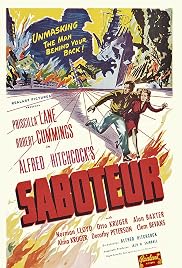
Saboteur (1942), 7+ {nm}

Aircraft factory worker Barry Kane goes on the run across the United States when he is wrongly accused of starting a fire that killed his best friend.
1h 49min | Thriller, War | 24 April 1942
Director: Alfred Hitchcock
Stars: Priscilla Lane, Robert Cummings, Otto Kruger, Norman Lloyd

http://www.imdb.com/title/tt0035279/

Decided to watch some non-musicals, especially during the war years. This shows an aircraft factory, which I wanted to contrast with Star Spangled Rhythm, not that I expect either to show % of women workers accurately. Here we have only a smattering of women, although one is prominent, causing NL to trip and fall.

I like RC better here than in his weak-men comedy roles. He plays an ordinary guy (with extraordinary powers of observation and recall, at least of that one envelope), and that's AH's specialty. I think I like PL in everything I've seen; she's a good actress and makes you think you might like to lunch with her.

The words 5th Column are not used here, but this is a definite sabotage organization, sympathetic to fascism as a form of government. (And what makes you think you'll be on the powerful end of the regime, rather than just another victim?)

As is typical with AH, we get a satisfying ending without any tedious denouement. 

Frank Lloyd Prod./Universal, dir. Hitchcock; 7+

Ship Ahoy (1942), 6+

Miss Winters is a dancer with the Tommy Dorsey Orchestra and is asked to secretly transport a prototype magnetic mine to Puerto Rico. She thinks that she is working for the US Government, ... 
1h 35min | Comedy, Musical, Romance | May 1942
Director: Edward Buzzell
Stars: Eleanor Powell, Red Skelton, Bert Lahr.
Bobby Connolly ... dance director

bootleg; ok print, but gets blurry during a dance sequence

Weird that RS is in a sailor outfit on the poster. He is definitely a civilian, and when they had a costume night, he was a cave man.

A definite wartime plot, with a Japanese-looking co-conspirator (Philip Ahn). And frankly, it's too much plot for me, especially since it's just a matter of an object being smuggled, then being misplaced, recovered, handed to its intended recipient, but recovered by the feds (I think; I really got bored with it.) Very little action or suspense.

Good music, good dancing, lots of it. In the Tap! Appendix for EP and Stump (James Cross) and Stumpy (Eddie Hartman). S&S are fun to watch; the taller one fools you into thinking he's only there for comedy, and then dances in lockstep with the identified dancer, both doing multiple mid-air semi-splits. They dance their one number after the song Poor You has been sung by Frank Sinatra, then by RS, and then by Virginia O'Brien. Did I mention S&S are black? Yes, their scene would be excisable.

Poor You is a song with clever lyrics, proclaiming love in an unusual way. Author: Yip Harburg, he of Over the Rainbow and other marvels.

Tommy Dorsey & his orchestra are shown a few times, including an instrumental-only swing rendition of the Hawaiian War Chant; very apropos for the time. EP is introduced in the film dancing to the last bit of this song with chorus girls; the choreography reminded me of her hula-tap number in Honolulu. Buddy Rich is announced by name, with his initials on the bass drum.

This is Sinatra's 2nd film. He does not have onscreen credit; he's just another singer with the band. (S&S _do_ have onscreen credit.) 4 films later, in '45, he's co-starring with Gene Kelley in Anchors Aweigh.

Part of why I'm not excited by the dancing is its staging and photography. We're definitely constrained by the venues in which she's performing. No fantasy here. And she very very briefly has a partner, which looks terrific and then he sits down. She does none of her gymnastics. And while she likely worked hard to twirl that cape as well as she does, I like dancing, not prop manipulation. When she finally does dance in that number, she does a faint impression of flamenco.

Previously rated 7. Maybe I'll bounce back up at a future viewing.

MGM, dir. Buzzell; 6+

Star Spangled Rhythm (1942), 8

A Paramount Studios security guard who was a major actor during the silent film era must carry out the illusion that he is still a big deal when his sailor son comes to visit.
1h 39min | Comedy, Musical | 2 December 1942
Directors: George Marshall, A. Edward Sutherland (uncredited)
Stars: Victor Moore, Betty Hutton, Eddie Bracken and more than a dozen Paramount stars.
George Balanchine ... choreographer for miss zorina
Daniel Dare ... choreographer (as Danny Dare)

http://www.imdb.com/title/tt0035379/

Very disappointing that IMDb says this was released 5 Mar 1942 in Argentina, which seems unlikely, unless things were added for the American release. Now I have ideas in my head that are 9 months ahead of their time, and those are significant months. (I submitted a correction.)

At this website about the war effort, they say "As early as February 1942, women were responding to local calls to enter the workforce." In this film, we have a musical number set in a stylized aircraft plant employing equal numbers of men and women (Dona Drake is featured here; doesn't dance much). We also have Bob Hope, as MC of the show making jokes about women in the workforce. Those sound like accepted ideas from the latter part of '42, not the early part.

I love this film for the comedy and the music and the war effort. I'll bet that by the end of this post I'll have talked myself into bumping this from a prior 7 to an 8. Here are my favorite scenes:
  • 4. Hit the Road to Dreamland: Dick Powell (yay!) and Mary Martin sing in a film clip that Preston Sturges is screening. They're alone in the dining car of a moving train, after 2 a.m., and the waiters want to close up. As they sing their duet, the 4 black waiters (The Golden Gate Quartette (sic)) sing their reasons for asking them to go. All 6 voices are gorgeous.
  • 5. Swing Shift: Dona Drake, Marjorie Reynolds and Betty Jane Rhodes and dozens of chorus boys and girls "employed" at an aircraft factory, singing and dancing.
  • 6. I'm Doing It for Defense: Betty Hutton singing to Eddie Bracken with his navy pals and Victor Moore in a jeep in a loony 1-car all-terrain chase sequence.
  • 8. over the wall, with BH and 2 comic acrobats, one trying to help her, the other trying to hinder that effort. It looks like BH herself comes crashing down to the ground in at least one attempt. I love how Fred MacMurray gets involved once she's reached the other side.
  • 10. A Sweater, a Sarong and a Peek-a-boo Bang: Paulette Goddard, Dorothy Lamour and Veronica Lake, followed by Arthur Treacher, Walter Catlett and Sterling Holloway singing and strutting.
  • 13. That Old Black Magic: Vera Zorina dances alone in a soldier's dreams. (She finally leaps!) But for singing/arrangement, this pales compared with Louis Prima and Keely Smith.
  • 15. Sharp as a Tack: Eddie Rochester Anderson and Katherine Dunham strut with chorus boys and girls, singing the glories of zoot suits, until uniforms become more appealing. (In the Tap! Appendix (actually from Jazz Dance by Stearns, 1994) for Dunham.)
  • 16. wife, husband and wolf: Bob Hope in the shower with William Bendix. I need more WB comedy time.
I believe I complained about BH&EB in their prior outing. But here they are so over the top that they really achieve Funny. But we get taken away from them often+long enough that they're tolerable.

Maybe next time through, especially if they fix the release date so I can truly see it in sequence, I'll want to bump it to a 9. 

Paramount, dir. Marshall & Sutherland; 8